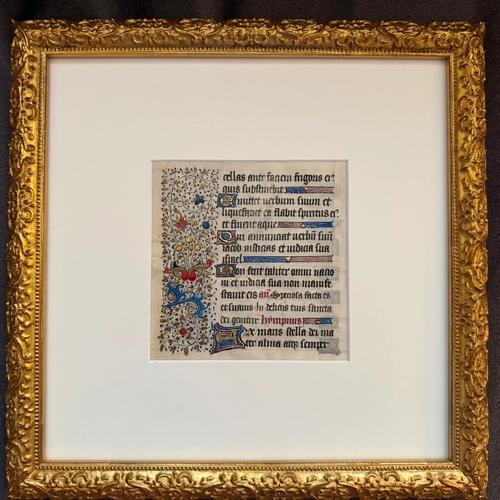
Illuminated Manuscript Leaf, Book of Hours, Vespers Psalm & Ave Maris Stella
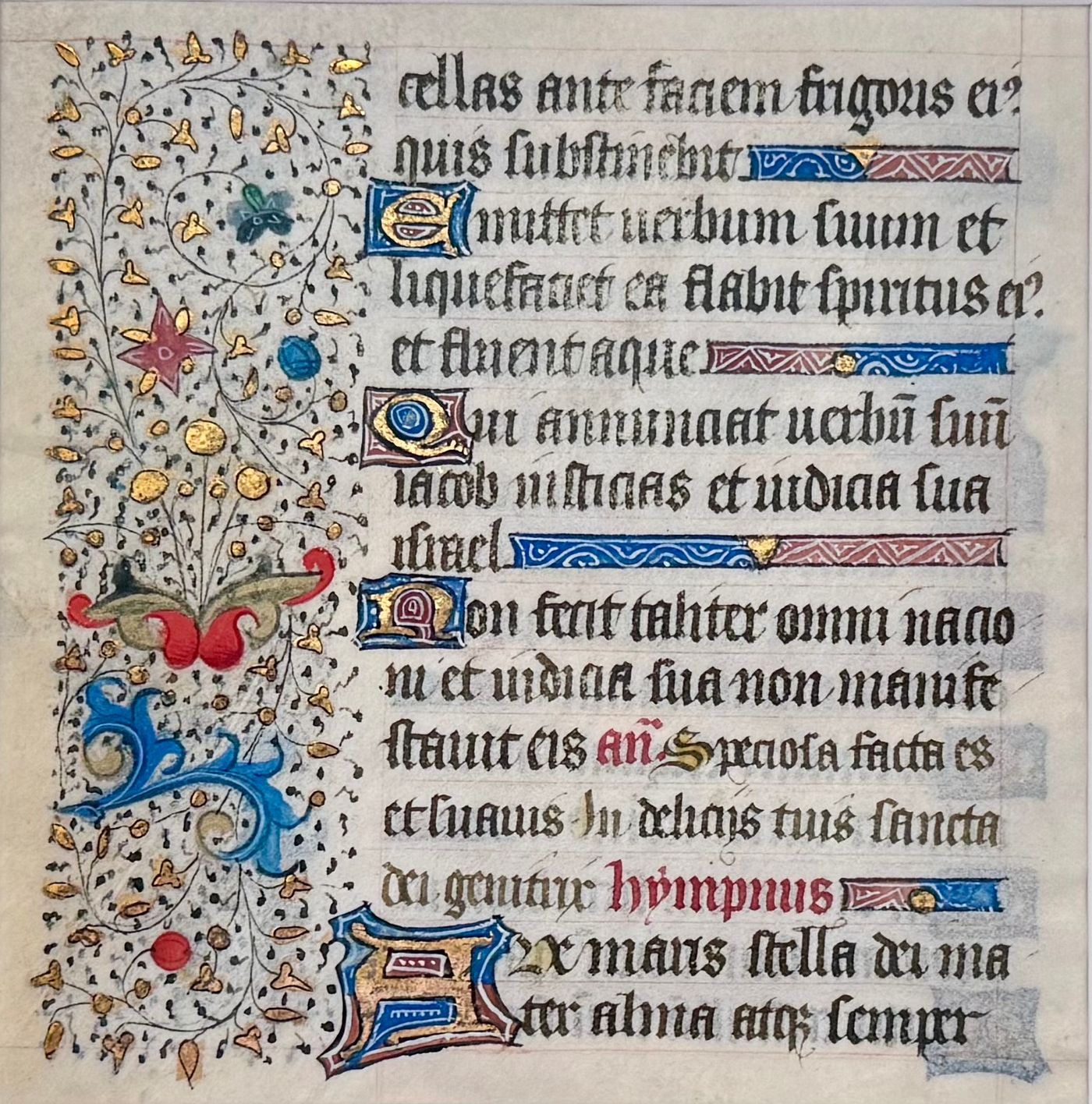
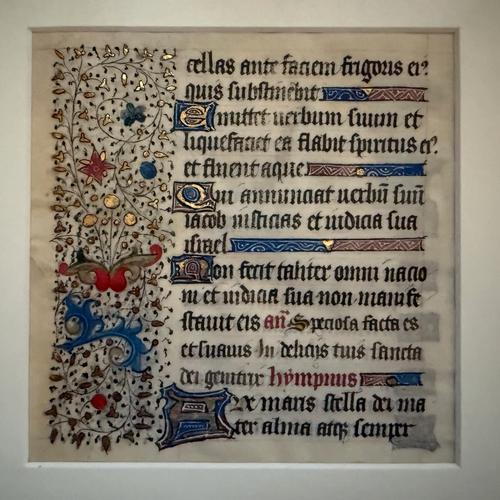
Single leaf, 15 long lines of a rounded gothic textualis with cursive (bâtarde) leanings, written in dark brown ink, ruled, with full-height vine border to one margin. Four two-line initials in burnished gold on parti-coloured grounds of blue and maroon heightened with fine white penwork — that opening the hymn (A of Ave) the most prominent; ribbon line-fillers in the same palette; two-line rubrics in rose-pink (antiphona; hymnus). The outer margin carries an ivy-spray border of hairline tendrils strung with burnished-gold trefoil bezants and black penwork sprays, relieved by naturalistic blooms — a red star-flower, blue acanthus, and clustered red berries. Reverse not examined; condition apparently fresh, the gold bright, colours vibrant.
TEXT: The leaf preserves the close of Psalm 147 (Vulgate; vv. 6–9, = Ps. 147:17–20 in the Hebrew and modern numbering), one of the psalms sung at Vespers in the Hours of the Virgin: …[buc]cellas. Ante faciem frigoris eius quis sustinebit? Emittet verbum suum, et liquefaciet ea; flabit spiritus eius, et fluent aquae. Qui annuntiat verbum suum Iacob, iustitias et iudicia sua Israel. Non fecit taliter omni nationi, et iudicia sua non manifestavit eis. There follows the Marian antiphon Speciosa facta es et suavis in deliciis tuis, sancta Dei genitrix, and then, beneath the rubric Hymnus, the celebrated incipit Ave maris stella, Dei mater alma, atque semper [virgo]…
Translation — the psalm after the Douay-Rheims (Challoner) version; the antiphon and hymn rendered literally.
…like morsels: who shall stand before the face of his cold? He shall send out his word, and shall melt them: his wind shall blow, and the waters shall run. Who declareth his word to Jacob: his justices and his judgments to Israel. He hath not done in like manner to every nation: and his judgments he hath not made manifest to them.
Antiphon. Beautiful and sweet have you become in your delights, O holy Mother of God.
Hymn. Hail, star of the sea, loving Mother of God, and ever Virgin…
The abbreviations are those of a practised liturgical hand: the looped -us sign for eius (twice over), the macron for terminal -m in uerbū suū (verbum suum), and the z-shaped enclitic of atqʒ (atque), together with the period orthographies delicijs (deliciis) and the unetymological hympnus.
The sequence — Vespers psalmody resolving into the Marian antiphon and the hymn Ave maris stella — identifies the parent volume securely as a Book of Hours, the leaf falling at Vespers of the Hours of the Virgin. The rounded liturgical script, the gold initials on blue-and-maroon grounds with white tracery, the ribbon line-fillers, and above all the fine ivy-rinceaux border sown with gold bezants and a sparing scatter of coloured flowers belong to the common idiom of accomplished commercial illumination of the third quarter of the fifteenth century — at home in Paris, Rouen, or the workshops of the Southern Netherlands alike. On the evidence of a single leaf a tighter localisation is best left open. A fresh and charming example, the burnished gold scarcely rubbed.