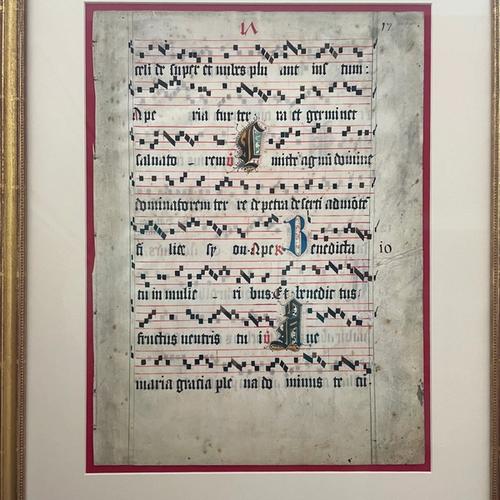
Illuminated Manuscript Leaf from a Large Gradual, Ave Maria
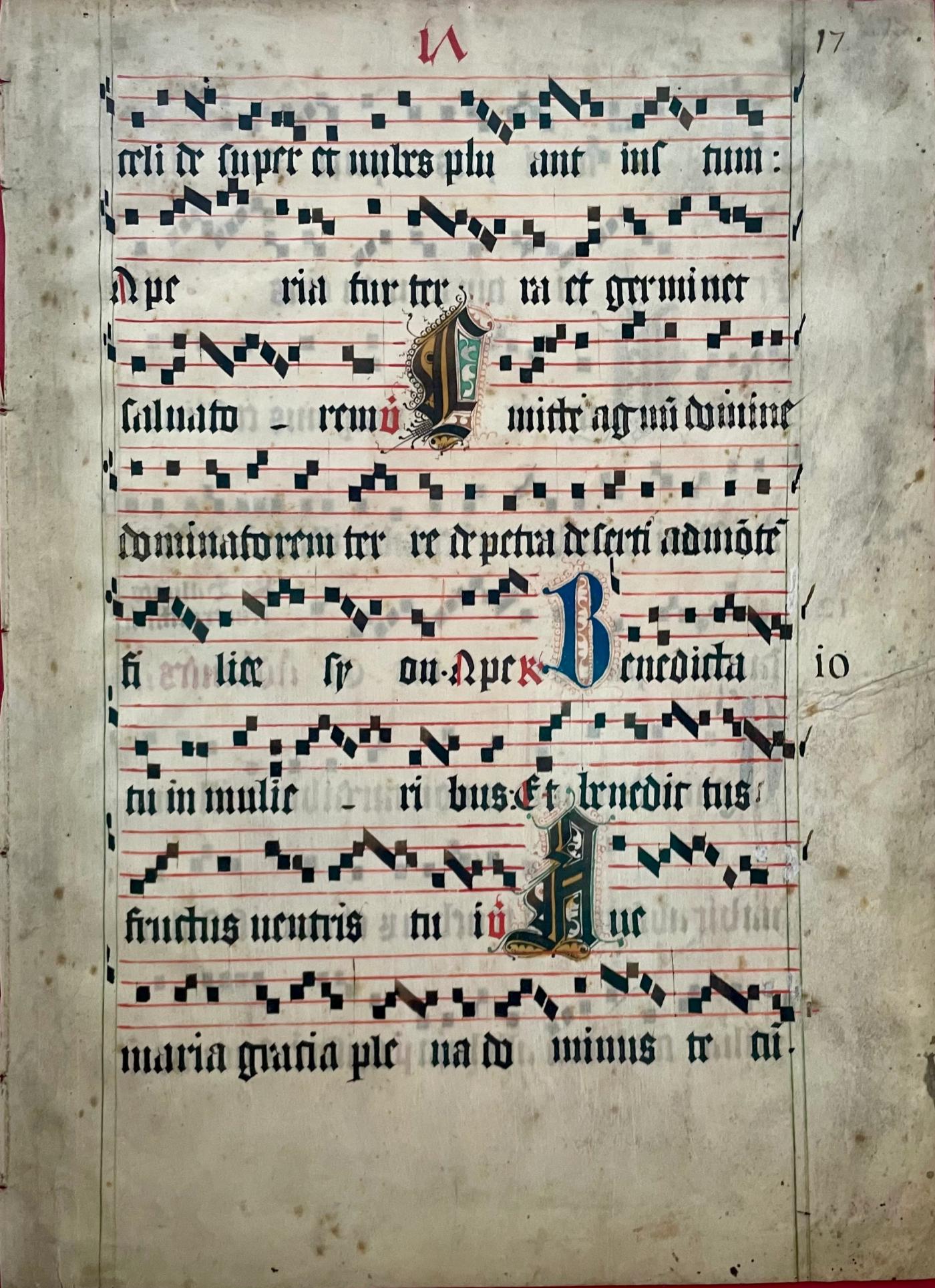
Single leaf from a large choirbook (antiphoner), carrying eight four-line staves ruled in red with square (quadratic) notation in black, each underlaid with a line of large gothic textualis formata in dark brown ink. Three large initials in burnished gold and colours — blue, green, and black with red penwork flourishes and grotesque tails — marking the openings E (Emitte), B (Benedicta), and A(Ave); smaller versals and scribal cues touched in red. Red guide-letter at the head; later foliation ‘17’ (upper right) and item number ‘10’ in the margin. [Reverse not examined; parchment lightly soiled and cockled with some show-through, the notation and gilding fresh.]
TEXT
The leaf preserves a sequence of Advent chants of pronounced Marian character. In order: [Rorate] caeli desuper, et nubes pluant iustum: aperiatur terra, et germinet Salvatorem (Isaiah 45:8); Emitte agnum, Domine, dominatorem terrae, de petra deserti, ad montem filiae Sion (Isaiah 16:1); Benedicta tu in mulieribus, et benedictus fructus ventris tui (Luke 1:42); and Ave Maria, gratia plena, Dominus tecum (Luke 1:28). A red scribal cue, Aper[iatur], set before Benedicta, directs the singers back to the ‘Aperiatur terra…’ phrase as a repetendum. The underlay is fluent gothic, with the usual suspensions (dūine for Domine, agnū for agnum, mōtefor montem, tecū for tecum) and the spelling syon for Sion.
Translation — the chant texts rendered literally.
…drop down, ye heavens, from above, and let the clouds rain down the Just One: let the earth be opened and bring forth a Saviour. Send forth the Lamb, O Lord, the ruler of the earth, from the rock of the desert to the mount of the daughter of Sion. Blessed art thou among women, and blessed is the fruit of thy womb. Hail Mary, full of grace, the Lord is with thee.
COMMENTARY
The texts and their season place the leaf in the Advent portion of an antiphoner — the choirbook from which the Divine Office was sung — and in its later reaches: Emitte agnum is assigned in the chant tradition to the Ember days of the third week of Advent, and Rorate caeli, Ave Maria, and Benedicta tu all belong to the same Annunciation-tinged approach to the Nativity. The grand format, the square notation on a red four-line staff, and the large gothic textualis are those of a fifteenth- or sixteenth-century choirbook made for communal use at the lectern. The square (quadratic) notation, as against the nail-headed Hufnagelschrift of the German lands, suggest a French, Italian, or English origin; a firmer localisation is difficult on the evidence of the single leaf alone.