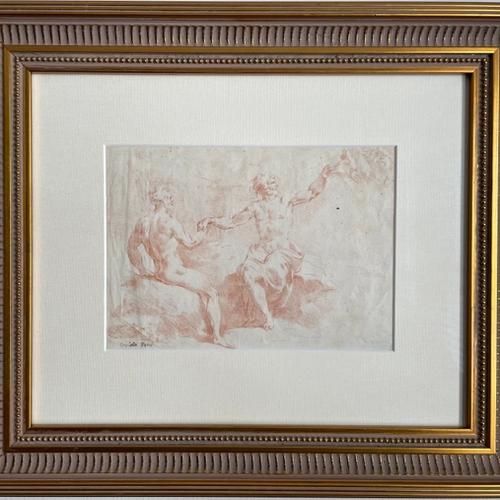
Old Master drawing, attributed to Guido Reni (1575–1642)
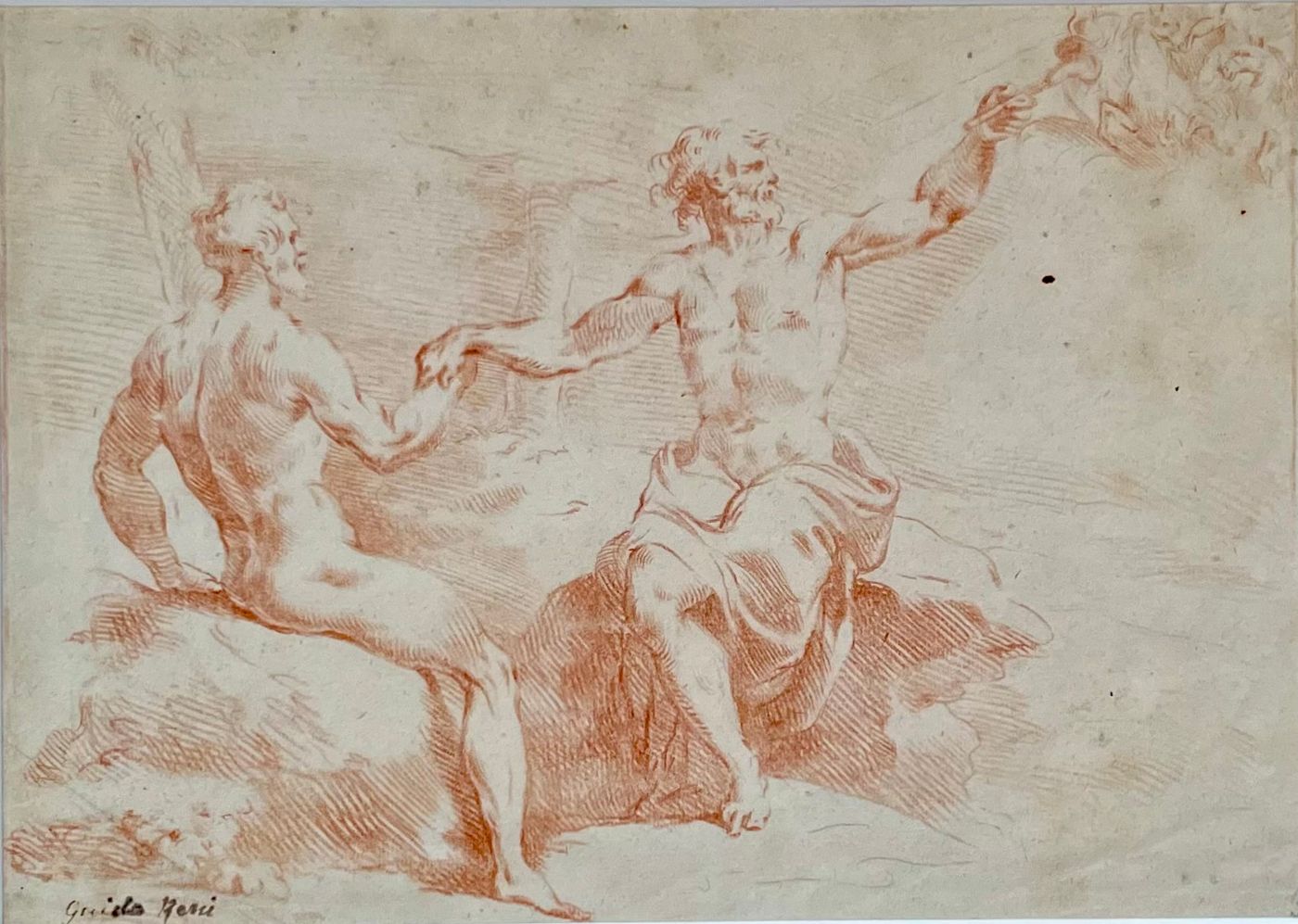
The drawing shows two muscular male figures seated upon rocks in an open, lightly indicated landscape. At the left, a man reaches across toward his companion; at the right, an older, bearded man, nude to the waist and draped about the legs, turns away from the picture plane, his arm outstretched towards the upper right, where a team of horses and at least one further figure are summarily sketched — the upraised hand apparently grasping a flaming brand or torch. The whole is worked in red chalk with the assured parallel hatching and firm contour of an accomplished academician: the modelling of the two nudes is confident and fully realised, while the secondary passages — the rocks, the sparse foliage, the distant horses — are left in rapid, abbreviated strokes, the economy of a practised inventor rather than a copyist.
The subject has not been securely identified. The gesture toward a team of horses in the heavens, taken with the upheld brand, points to a celestial or visionary theme. One possibility, advanced only tentatively, is the vision of Saint John on Patmos and the horsemen of the Book of Revelation, the figure at the left perhaps answering to the angel who reveals the apocalyptic riders to the seated Evangelist. A classical reading is equally admissible — a deity or hero gesturing toward the chariot and horses of the Sun, a motif familiar from Reni’s own Aurora — and it is possible, too, that the sheet is in essence an académie, a studied invention of two nudes not tied to any finished narrative. The matter is best left open.
Red chalk was a favoured medium of the Bolognese Seicento, and the clear, firm draughtsmanship and balletic male nudes seen here belong unmistakably to that school — the tradition of the Carracci academy in which Reni was formed, and which he carried to its most graceful pitch. The early ink inscription Guido Reni at the lower left preserves a traditional attribution to the most celebrated of those masters. Such inscriptions record old opinion rather than establishing authorship, and Reni’s name — like that of few others — was attached over the centuries to a great many drawings issuing from his large workshop, his pupils (Simone Cantarini, Elisabetta Sirani, and others), and his later followers. What can be said with confidence is that the sheet is the work of a trained and fluent hand within Reni’s orbit, of real quality; confirmation or refinement of the name would best be sought from a specialist in Bolognese drawings, by direct comparison with Reni’s documented red-chalk studies.