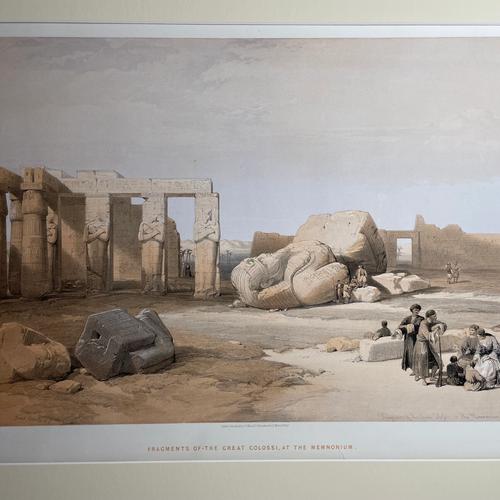
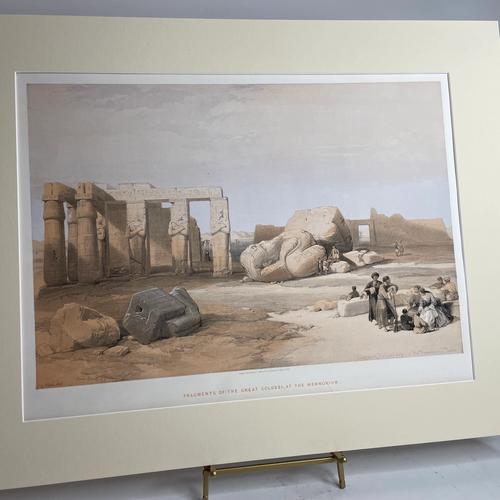
Fragments of the Great Colossi, at the Memnonium, Thebes
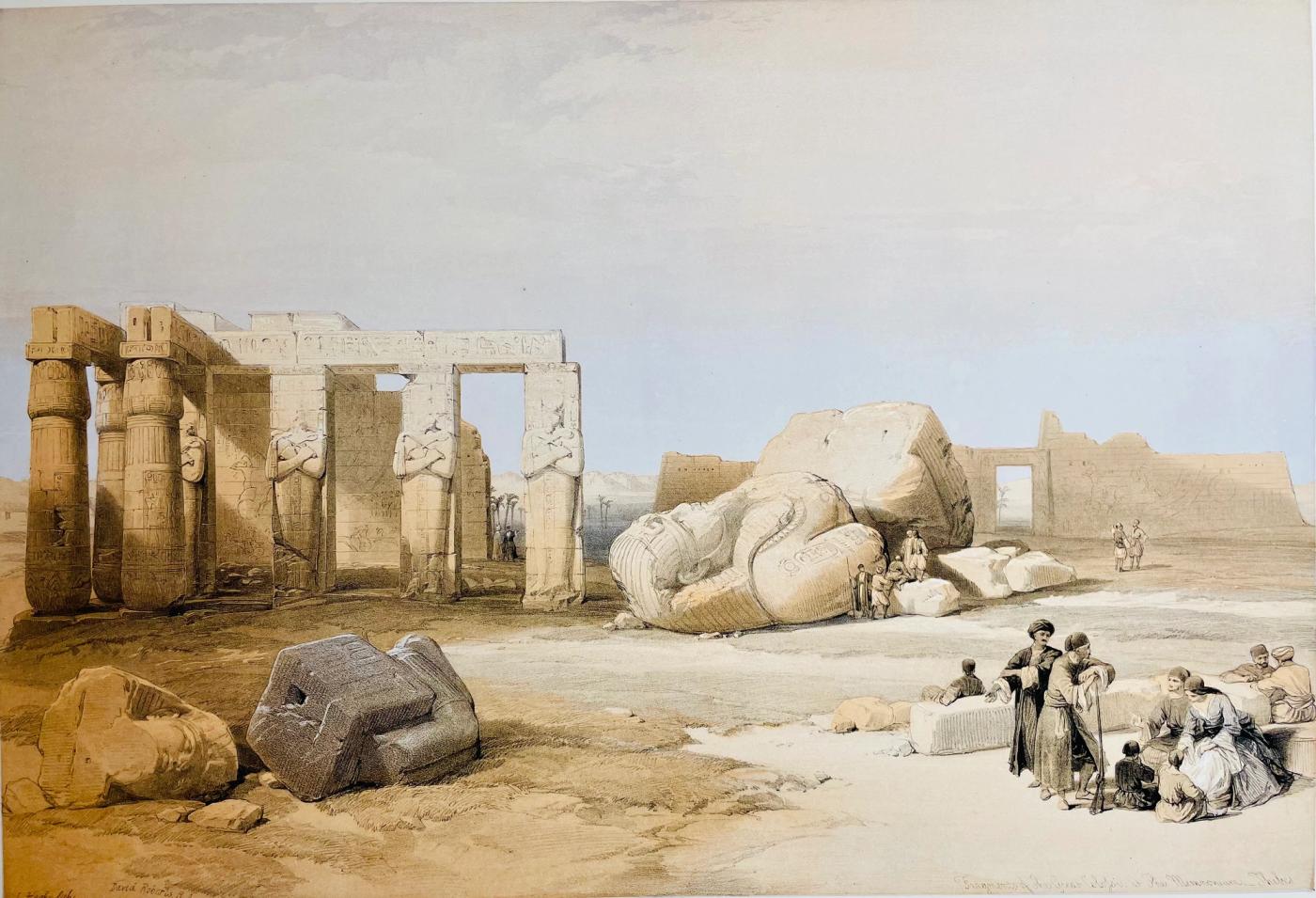
‘Fragments of the Great Colossi, at the Memnonium, Thebes’. F. G. Moon, 20 Threadneedle Street, London, 1842–49.
The Memnonium is a term that goes back at least to the Roman era geographer Strabo for the Theban Necropolis, on account of the colossal figures (one of which lies broken on its side in this plate) which since antiquity had been equated with the mythical hero Memnon, antagonist of Achilles in the Aethiopis, one of the poems of the Greek Epic Cycle.
Roberts travelled extensively through the Near East in 1838–39, producing hundreds of sketches which he would later work up into finished drawings, watercolours and, in some instances, oil paintings, which served as the basis for the lithographs produced by the Dutch lithographer Louis Haghe. The original folio publication in the 1840s was in two formats: 1) The Royal Subscription Edition (RSE), in which all of the tinted lithographs were printed on thin paper mounted to card and hand-coloured in watercolour to the specifications of Roberts’ originals. 2) The more plentiful Standard Edition (SE), in which the tinted lithographs were printed directly on thick paper and issued uncoloured, with the option of additional hand-colouring to be added later at the discretion of the purchaser. A few plates, such as the Approach of the Simoon, were polychromatic lithographs, printed in both formats using a multiplicity of stones, though later hand-colouring of highlights is often found in these as well.