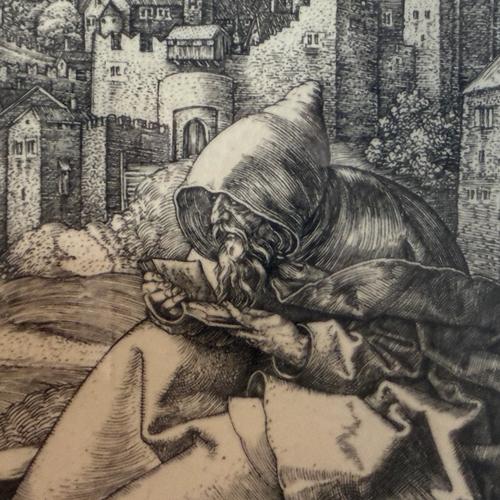
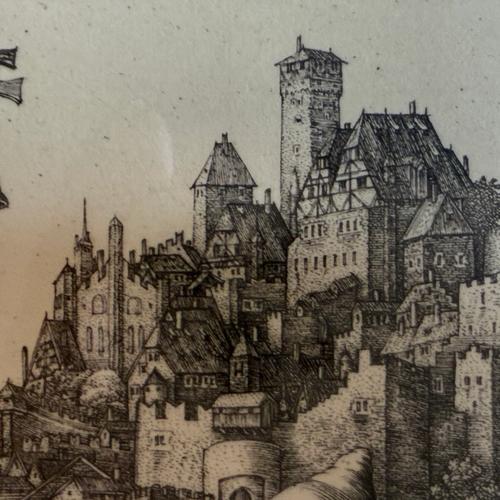
Saint Anthony Reading — After Dürer
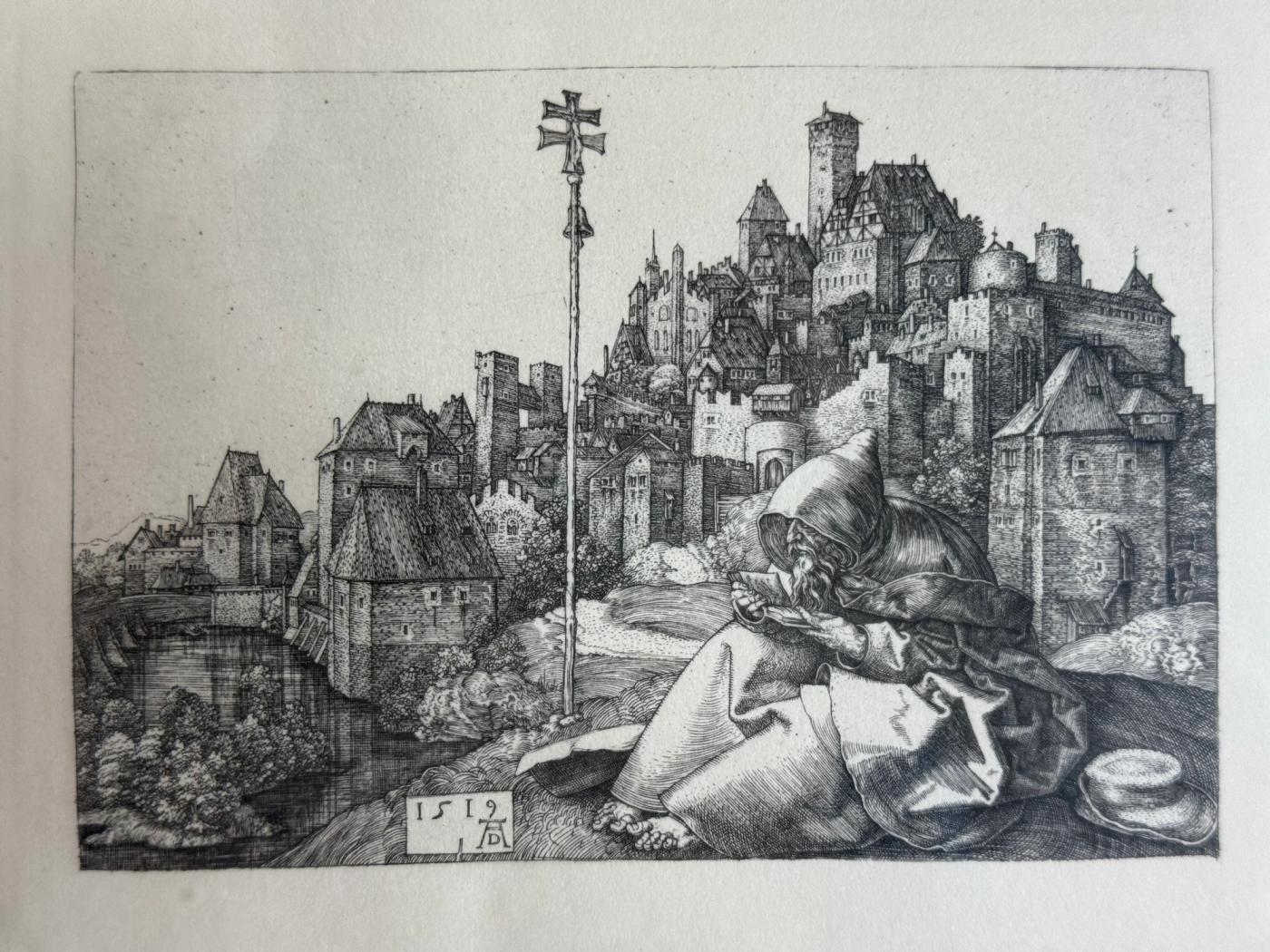
One of Dürer’s later works, the Saint Anthony captures the saint in a moment of quiet repose, stretching his toes as he reads a small book (perhaps a devotional book, often pocket-sized). A city rises on the hill behind him, its walls reflected in the still water of the river by which the saint sits. It is an intimate portrait that humanizes the great saint, a popular figure of devotion in the Middle Ages and Renaissance.
Though not examined out of frame, the print is likely a production of the Bundesdruckerei (federal press), a German state agency responsible for printing official documents (passports, stamps, bank notes, etc.). It was also given the right to issue ‘official’ reproductions of Dürer engravings in the 19th century (as the Reichsdruckerei). The copper plates were produced via heliogravure, an acid-based etching process that produces exact copies of originals. Thus the prints issued by the Bundesdruckerei are, along with those produced by Amand-Durand in the 19th century (who pioneered heliogravure), the closest approximation to Dürer’s originals available.