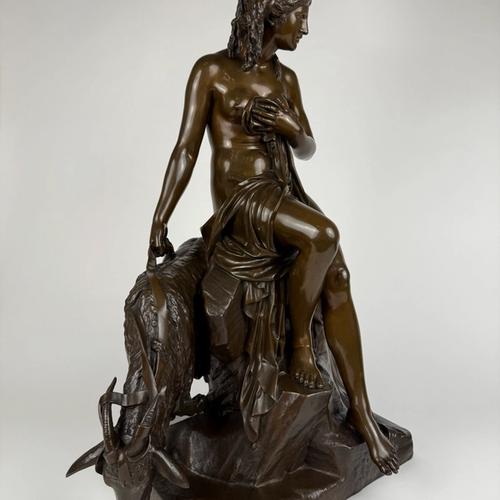
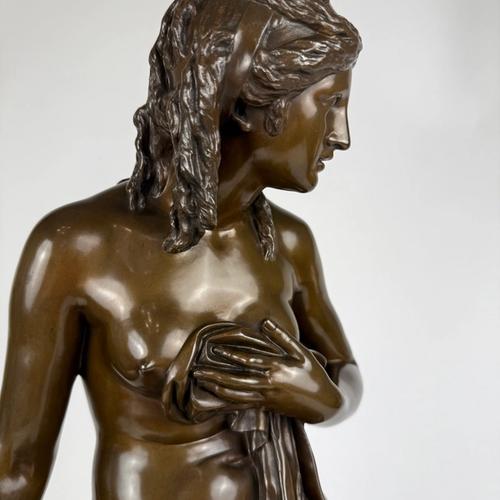
Amalthea and the Goat of Jupiter
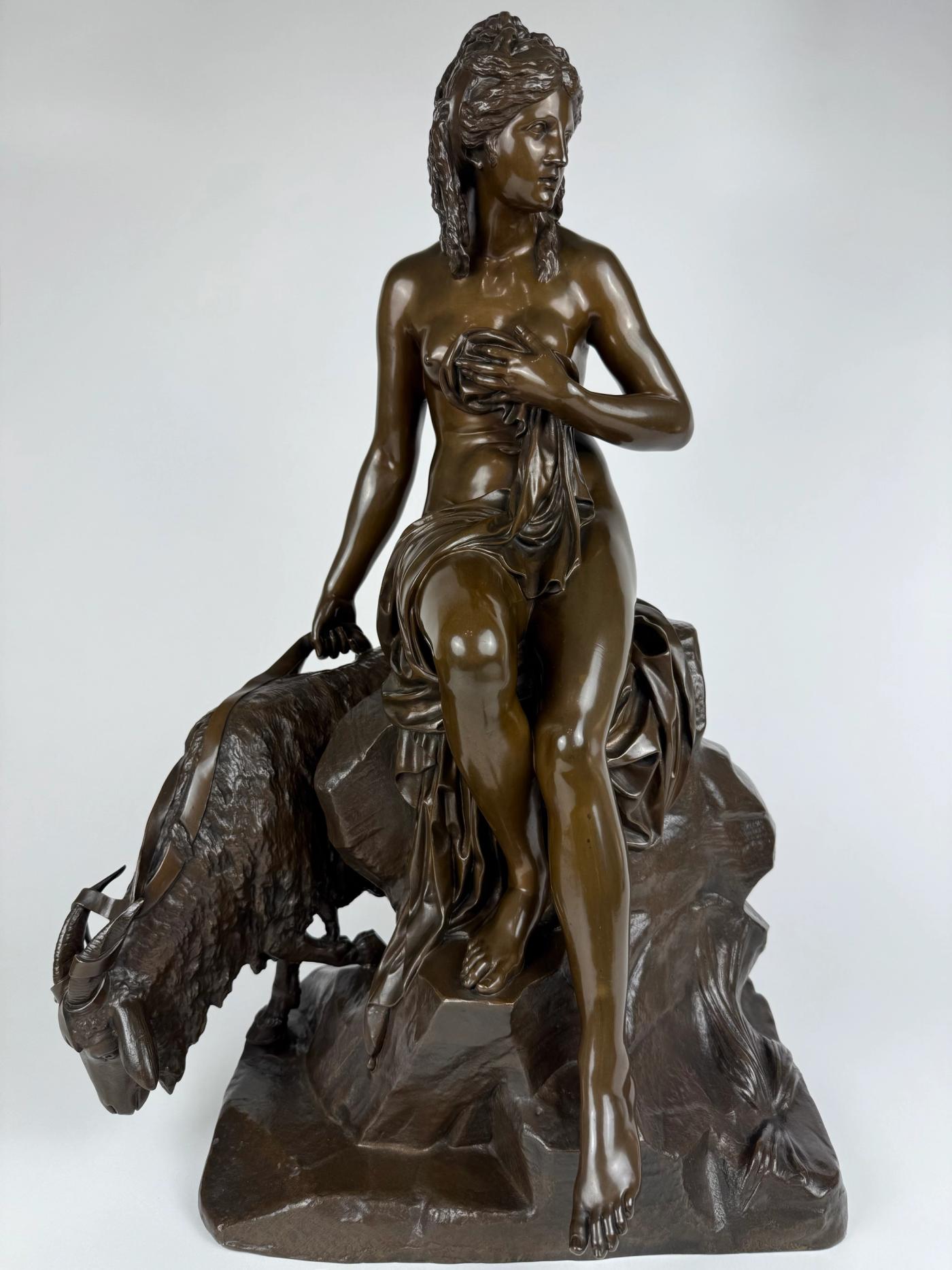
Julien’s sculpture references an old Greek myth, in which the infant Zeus (Roman Jupiter) is hidden from his father Kronos (Roman Saturn), intent on devouring all his children to prevent one of them from usurping him and claiming his kingship amongst the gods. Hera (Roman Juno) takes the baby off to Crete, where he is nursed in secret by the nymph Amalthea (and / or her goat, depending on the version of the myth). Zeus grows up, overthrows his father, rescues his siblings, and claims the throne of heaven.
The original larger-than-life-size marble sculpture was commissioned by Louis XVI for Marie Antoinette, specifically for the Queen’s Dairy at the Château de Rambouillet, a fantastical Classicising grotto and pavilion for the sampling of dairy products, adorned with paintings and sculptures by the greatest artists of the day (it is a popular tourist attraction to this day). The sculpture was moved to the Louvre in 1827, and returned to Rambouillet in 1953.
The Barbedienne foundry was the greatest foundry in 19th century France. In collaboration with Achille Collas, who had devised a mechanism for making mechanical reductions of sculpture that were identical to the original, Barbedienne issued numerous works, both ancient and modern. The Amalthea was produced in five sizes: 33-inch, 27-inch, 20-inch, 17-inch, and 13-inch. That on offer here is the 2nd reduction, relatively rare.