Cléopâtre Couchée
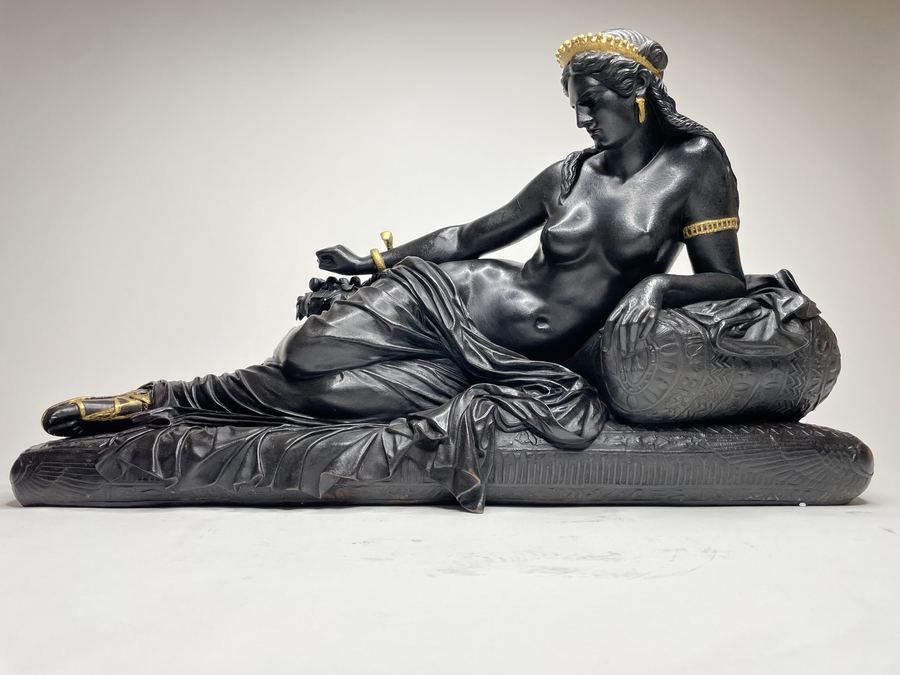
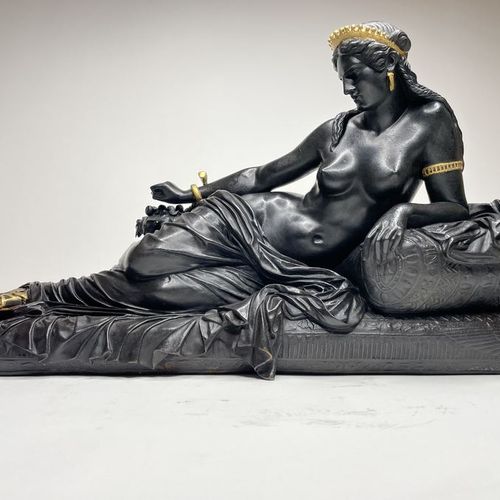
A large, rare, and spectacular example of Ducommun du Locle’s Cléopâtre, a prime example of Neoclassical / Egyptian Revival academic French sculpture from the mid 19th century. While Napoleon’s Egyptian Campaign of 1798–1801 was ultimately a military failure, it did result in opening up Egypt, and the art and culture of Ancient Egypt, to western Europe. In the decades that followed, ‘Egyptomania’ swept Europe and North America, aided in no small part by the publication of the monumental Description de l’Égypte by the Commission des sciences et arts d’Égypte (1809–29) and Champollion’s decipherment of hieroglyphics (1822–24). Roughly contemporary with du Locle’s Cléopâtre was the publication of David Roberts’ monumental Holy Land, Egypt, and Nubia, which provided a template for romanticised Orientalist depictions of Egypt for decades to follow.
Cleopatra of course was both romanticised and vilified long before the Egyptomania of the 19th century. Already in her lifetime she was revered and feared, a onetime ally turned enemy of Rome (depending on one’s political allegiance), a duality inherent in Horace’s famed Ode (Book 1, ode 37) Nunc est bibendum … Indeed, in du Locle’s composition, in which Cleopatra gazes placidly at the serpent coiling itself around her outstretched arm — freezing for eternity the moment of death — we can readily detect a reminiscence of Horace’s seventh stanza, ‘she had the fortitude to gaze upon her fallen palace with a serene countenance, and the courage to handle the sharp-toothed serpents, letting her body drink in their black venom’ (which of course eschews the more torrid visual representations often found in western art, in which the queen clutches the serpent to her bare breast).
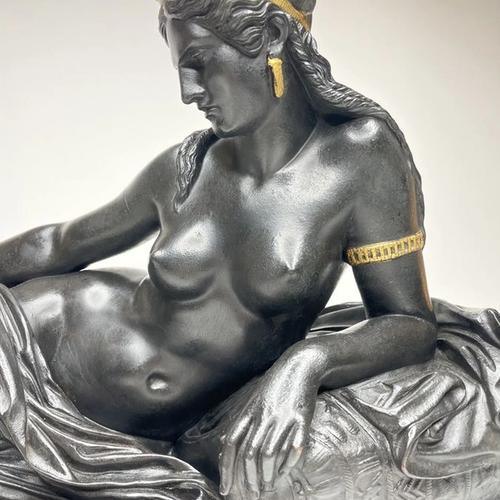
The pseudo-hieroglyphic decorations and winged-sun motifs at the corners of her couch establish the Egyptianising iconography, while the snake around her wrist unmistakably identifies the subject as Cleopatra. Yet the figure of the queen herself owes nothing to Egyptian art, and is rather inspired by Greco-Roman depictions of Aphrodite / Venus. Her bare breasts and torso, with her himation pulled down to the mid-point of her hip, are evocative of the Venus de Milo and Venus of Capua, as is the diadem on her head. In turn, Cleopatra’s full lips, prominent brow, and ‘Greek nose’ are common in 19th century French depictions of idealised beauty, including Delacroix’s Liberty Leading the People and Bertholdi’s Statue of Liberty.
Ducommun du Locle first exhibited his Cléopâtre in marble (slightly larger than life-size) in 1847 at the Paris Salon, and offered the sculpture to the musée des beaux-arts in his native Nantes (where it remains) two years later. In 1852, the French State commissioned a full-sized bronze copy, which now resides in the musée des beaux-arts in Marseille. It was likely around this time that the famed Barbedienne foundry issued castings of the Cléopâtre in several sizes, of which the 24½ inch version, offered here, is the largest. In this size it is quite rare, having last appeared at auction in 2009 (Sotheby’s New York, 20 April 2009, Sale no. N08537, lot 141).