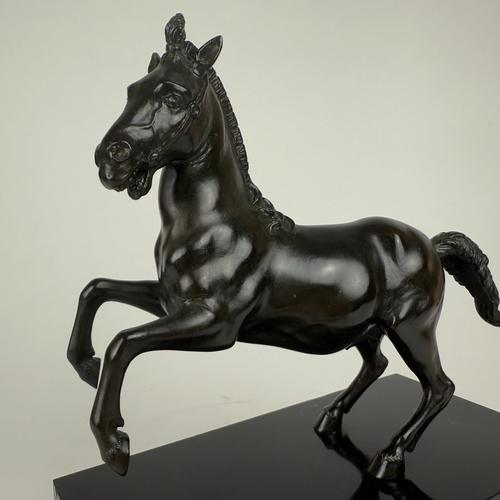
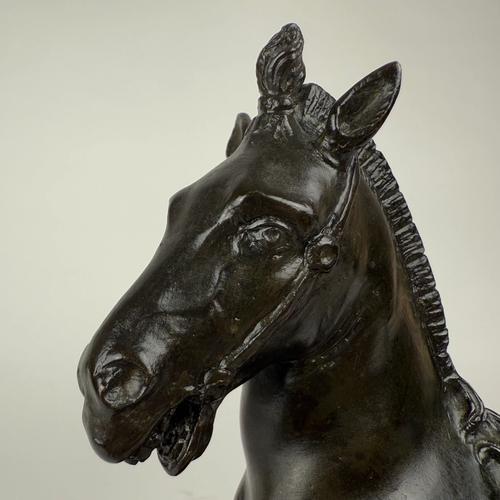
A Bronze Rearing Horse
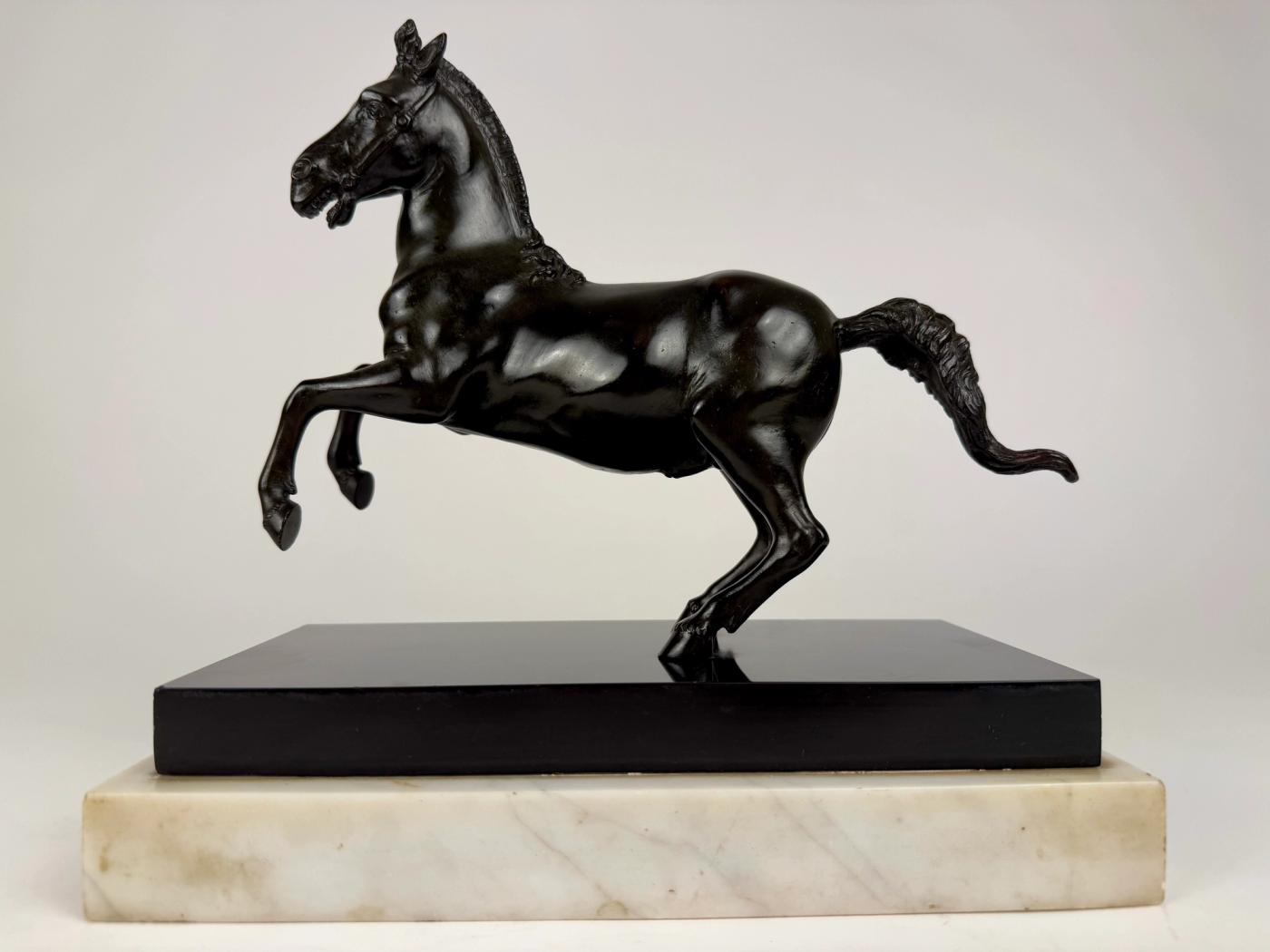
Modelled after a 1st century BC original discovered in Herculaneum in 1761.
The present sculpture is indisputably modelled on an equestrian bronze discovered in the vicinity of the theatre at Herculaneum in 1761 (Naples Archaeological Museum inventory number 4894). Two other equestrian sculptures were discovered in the same vicinity, one an Amazonian woman on horseback, and another the famed ‘Alexander the Great on horseback’. All are now in the Campania Gallery of the Naples Archaeological Museum. It has been conjectured that the three bronzes from Herculaneum are copies of a 4th century sculptural group by Lysippos and dedicated by Alexander himself in 334 BC to commemorate the fallen at the Battle of the Granicus River.
Equestrian bronzes, both mounted and riderless, were prevalent and popular from the Renaissance onwards, and stylistic similarities between the Herculanean horse offered here and other equestrian bronzes — from the Medici Riccardi Horse, to casts by Barthélemy Prieur, Francesco Fanelli, and Pietro and Ferdinando Tacca — have at times led to misattribution. Thus other casts of the sculpture offered here have in the past been misidentified as the work of Ferdinando Tacca (e.g. Bonhams, London, 13 February 2024, lot 131).