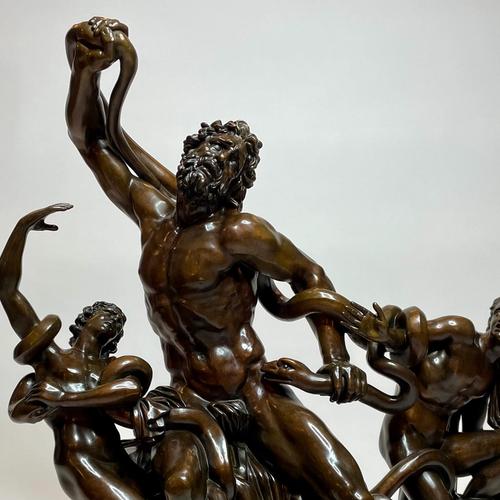
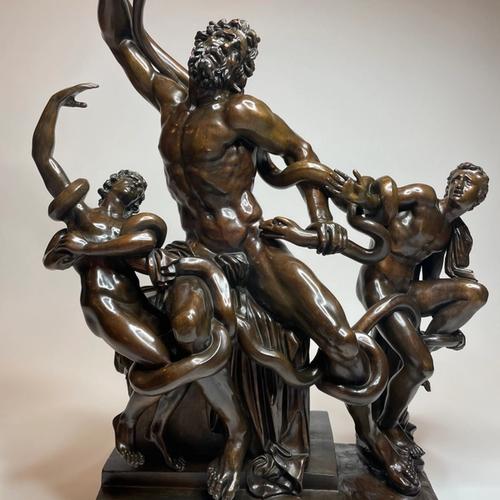
Laocoön and his Sons
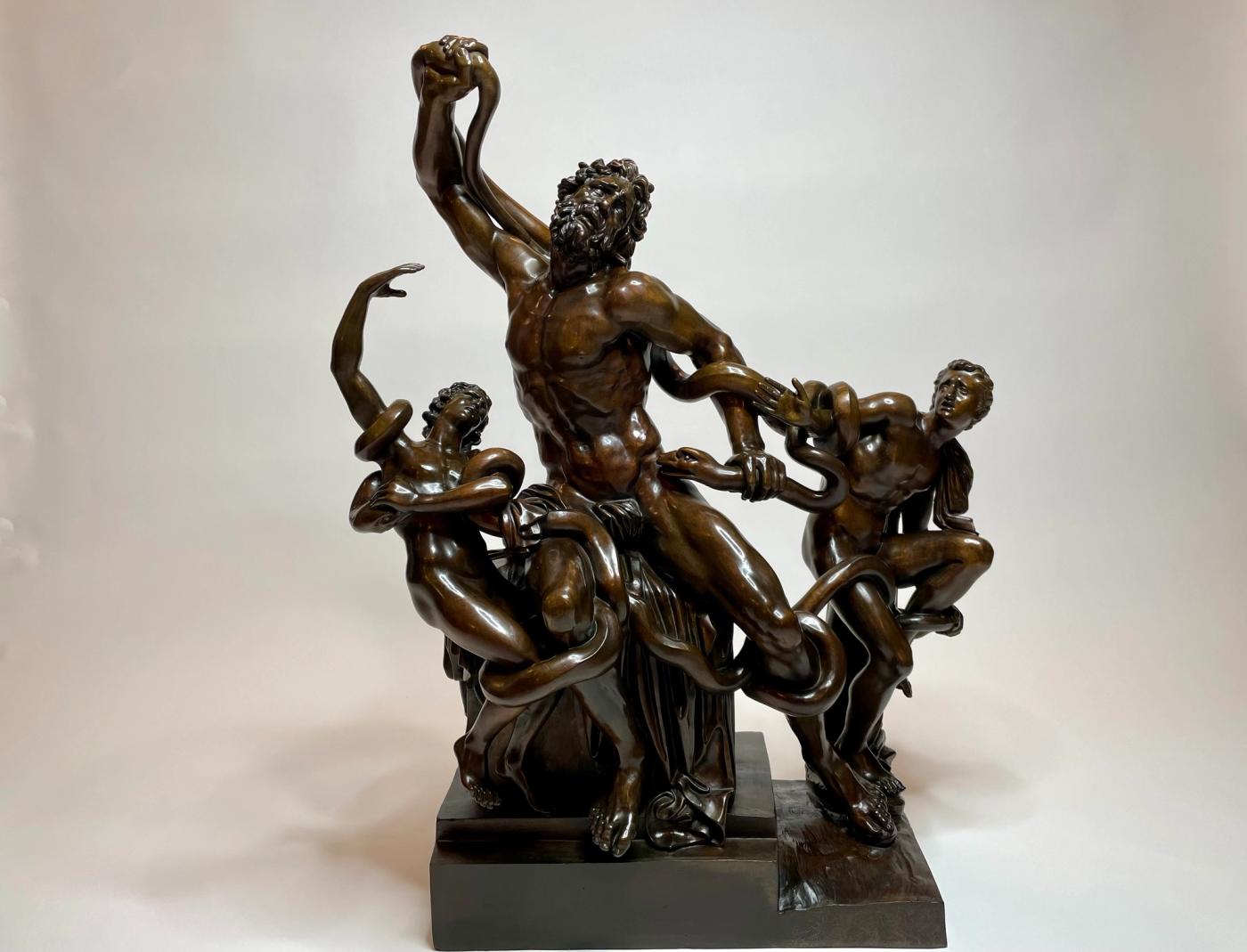
The Laocoön figural group is arguably the greatest and most influential sculpture to have survived from Greco-Roman antiquity. The original on which the present cast is based is a slightly larger than life-sized marble sculpture dated to the 1st century AD, which in turn is believed to be a copy of an earlier Greek bronze original (as many of the best Roman marble sculptures were). Since the discovery of the Laocoön group, it has been common to identify the extant sculpture with one mentioned in Pliny’s Natural History as the work of three Rhodian sculptors of the Augustan period, and in the Imperial collection of the Emperor Titus in Pliny’s day.
Laocoön was a figure in the mythic cycle of Troy, a priest of Neptune who played a seminal role in the final days of Troy. The subject of a lost play by Sophocles, Laocoön is most famous from the Second Book of Virgil’s Aeneid, where he warns the Trojans in vain not to accept the ‘gift’ of the Wooden Horse left behind by the seemingly departed Greeks. In Virgil’s account, Athena sends two monstrous snakes across the sea from Tenedos, who devour Laocoön and his two sons before slithering off to the temple of Athena on the citadel of Troy. The credulous Trojans take it as a sign of Laocoön’s impiety in rejecting the horse, and thus wheel the mechanism into the city, sealing their fates. Two of the poem’s most famous lines are spoken by Laocoön (Aeneid Book 2, lines 49–50): equo ne credite, Teucri; / quidquid id est, timeo Danaos et dona ferentes — ‘Do not trust the horse, Teucrians! Whatever it is, I fear the Greeks, even when bearing gifts’ — origin of the phrase ‘Greeks bearing gifts’, used of the untrustworthiness of enemies who seem to be offering gifts or concessions.
The modern history of the sculpture begins with its chance discovery in a vineyard in Rome in 1505, at the apogee of the Italian Renaissance. Its quality and importance were immediately recognised, and the recently elected Pope Julius II (patron of Michelangelo and Raphael, amongst others) quickly purchased it and had it transferred to the Belvedere Palace at the Vatican. Indeed, it was Julius’ acquisition of the Laocoön, along with a few other pieces including the Belvedere Apollo discovered a few years later, that laid the foundation of what would become the Vatican Museum.
Several pieces were missing from the sculpture when discovered, most notably the proper right arm of the central figure. Julius instituted a competition, overseen by Raphael, to solicit suggestions for restoration and reconstruction from the greatest artists of the day. Jacopo Sansovino won with a proposal for the arm extended upwards in a heroic gesture of exertion. Michelangelo, who did not submit a proposal, dissented, and suggested the arm was twisted behind the figure’s back. Michelangelo would be proved right four hundred years later, when a large portion of the missing right arm was discovered near the original find spot in 1906. Thus the discrepancy between the sculpture as it now stands, and has stood for the better part of the 20th century, and earlier castings, drawings, and engravings showing the restoration of Sansovino.
The Laocoön played a central role in the ground-breaking work of Johann Winckelmann (1717–1768), who in many respects laid the groundwork for the emergence of art history as an academic discipline, while Lessing’s Laocoön: an Essay on the Limits of Painting and Poetry — in many respects a response to Winckelmann — was a seminal moment in the evolution of art and literary criticism.
From soon after its discovery, copies were cast by some of the greatest sculptors of the day, including Pier Jacopo Alari-Bonacolsi, called ‘Antico’ (1455–1528), Adriaen de Vries (1556–1626), and Giovanni Francesco Susini (1585–1623) (fine examples of the first and last can be found in the Princely Collection of Liechtenstein).