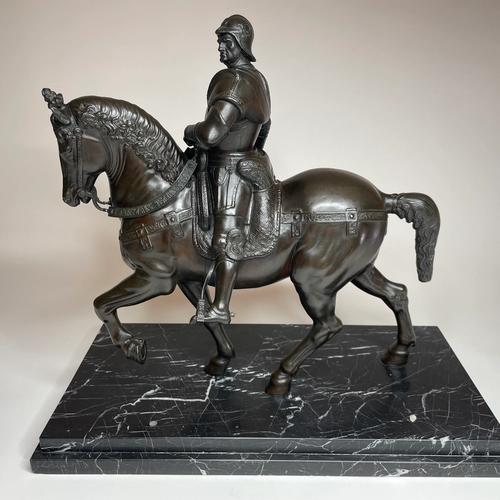
Equestrian Statue of Bartolomeo Colleoni
Verrocchio’s equestrian statue of Bartolomeo Colleoni is one of the great highlights of High Renaissance sculpture, along with Donatello’s earlier equestrian sculpture of Gattamelata (1453). Both Verrocchio and Donatello show indebtedness to the great Roman equestrian bronze of Marcus Aurelius, one of the few Roman bronzes to survive in view through the Middle Ages and into the Renaissance. In turn, many of the great equestrian bronzes of the later Renaissance and after, such as Giambologna’s equestrian monument of Duke Cosimo I de’ Medici (1592), and Susini’s ‘Giambologna’ horse inspired by the latter, all look back to Verrocchio and his predecessors.
Colleoni (1400–1475) was a condottiero — leader of a mercenary army — who fought for various masters during the mid-15th century. But it was his continued service for Venice, which elected him captain-general for life in 1455, that resulted in his immortalization by Verrocchio. The statue still stands where it was first erected in the 15th century in the Campo Santi Giovanni e Paolo in Venice.
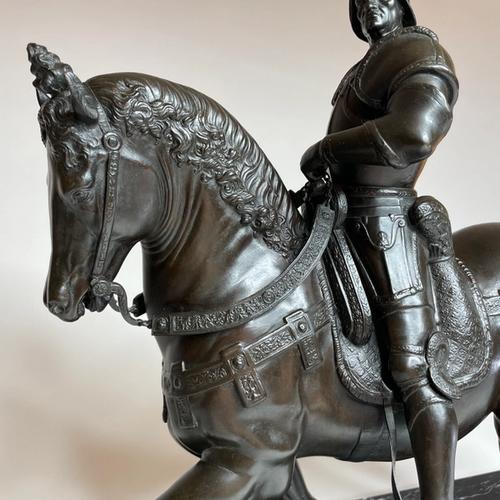
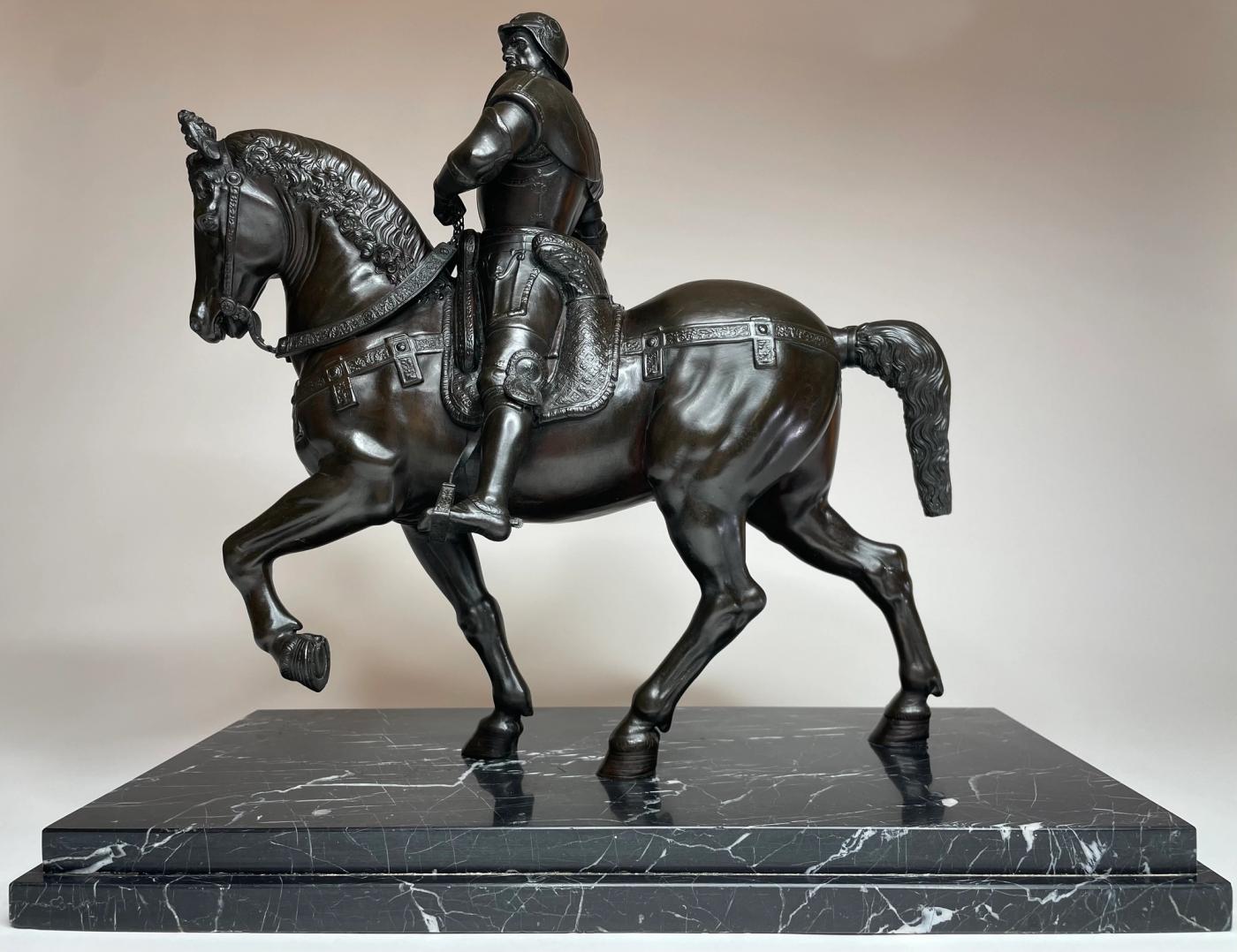
Many copies in various sizes were made in the 19th and early 20th century, but few show the exquisite and fine detailing seen in the present example. Note in particular the rich bas-relief detailing in the horse’s reins and bridle. The present copy is in near-immaculate condition, with hardly any signs of wear or losses — the stirrups and reins, here perfectly preserved, are particularly prone to damage and loss. Quite rare in such good condition.