1 / 12
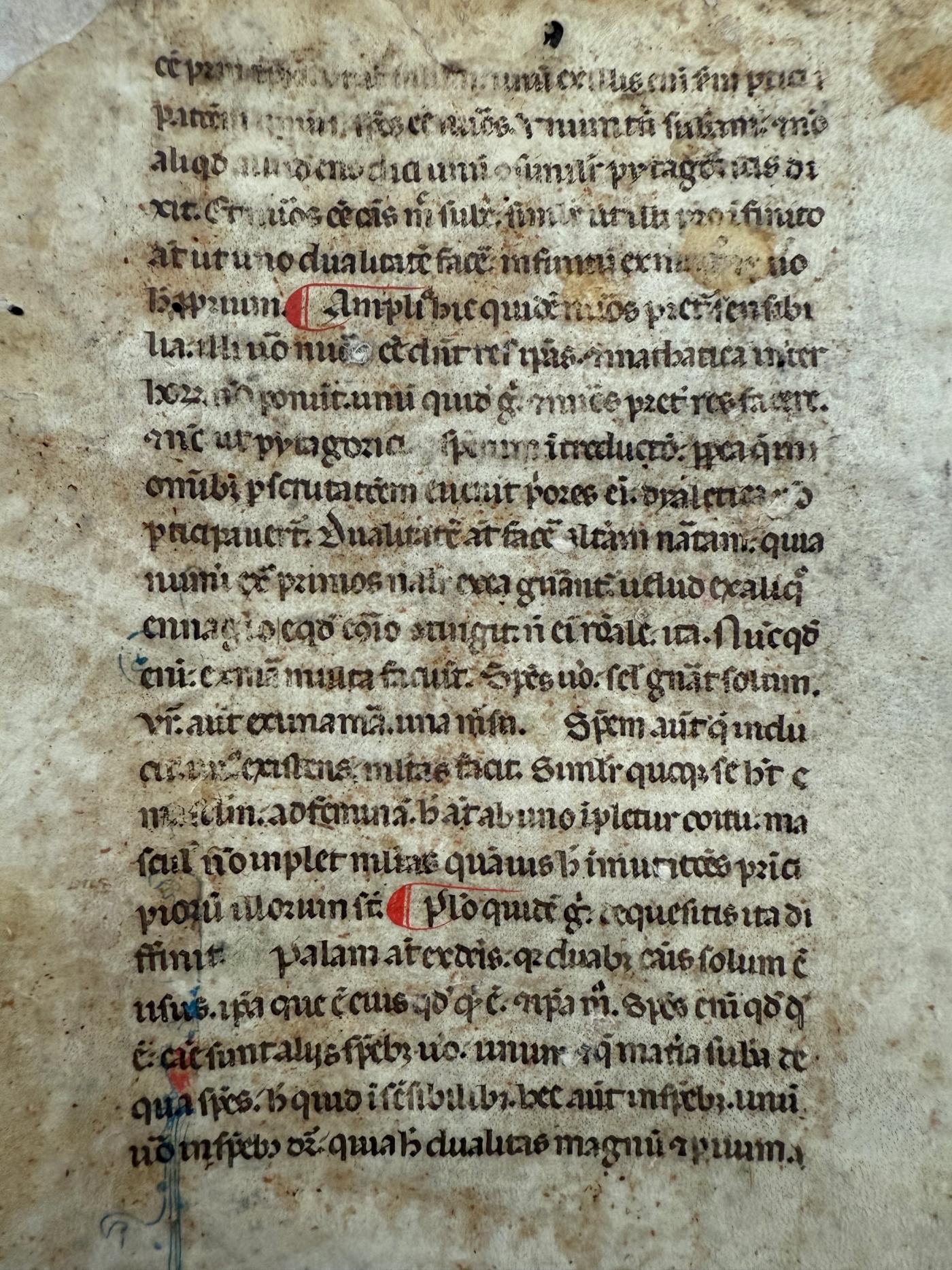
Single leaf from a 13th century Medieval Latin manuscript of Aristotle’s Metaphysics. Likely Northern France, possibly Parisian. Written in a flowing gothic script with multiple ligatures and abbreviations, rubricated paragraph markers, traces of marginal decoration visible at bottom left of column on recto.
A fascinating and rare scholastic manuscript leaf preserving part of Book I of Aristotle’s Metaphysics, containing the celebrated discussion of Platonic and Pythagorean number theory. The recto includes Aristotle’s analysis of Plato’s doctrine of the One and the Indefinite Dyad (magnum et parvum) and the well-known passage contrasting Plato’s doctrine of transcendent numbers with that of the Pythagoreans. The leaf belongs to the great flowering of Aristotelian studies in the medieval universities during the second half of the thirteenth century, when newly translated versions of Aristotle’s works transformed the teaching of philosophy throughout Europe.
The leaf begins with Metaphysics 1.6, 987b20 Bekker, e(ss)e prin[cipia, quasi vero substantiam] unum, ex illis eni(m) se(cundum) participationem … “[He (Plato) regarded the Great and the Small as the] material principles, and the One as the formal or substantial principle; for from the former, by participation in the One, the Forms come to be numbers.” Beginning with the first paragraph marker in line 6, we can read amplius hic quid[em] nu[mer]os preter sensibilia, illi v[er]o nu[mer]os e[ss]e d[icu]nt res ip[s]as, “furthermore, he (Plato) [held] that numbers exist apart from sensible things, whereas they (the Pythagoreans) say that numbers are things themselves.” (Square brackets indicating articulation of ligatures).
A unique and historic witness to the growing centrality of Aristotle in the high Scholastic period. While a few of Aristotle’s works had survived in the West in Latin translations from late Antiquity onwards (particularly in Boethius’ translations), it was only through the course of the 12th century that most of Aristotle’s corpus became known. In the east, James of Venice translated a number of Aristotle’s works from Greek into Latin while in Constantinople. In the West, in the wake of the reconquest of Toledo in 1085, translations of Aristotle from Arabic percolated throughout Europe (Michael Scotus’ in particular), as well as the great Arabic commentaries of Avicenna and Averroës. Thus through the course of the 12th century, Aristotle’s corpus became increasingly accessible in the west, revolutionizing Medieval thought and ushering in the scholastic period. In the 13th century William of Moerbeke completed the Latinization of the Aristotelean corpus, both translating new texts and revising the vetus and media traditions deriving from James of Venice, Michael Scotus, and others. The Metaphysics in particular was a controversial text, given the challenges it posed to received Christian doctrine, and in the earlier 13th century its teaching was banned at Paris. This of course only piqued readers’ interest, and so prevalently were the ‘dangerous’ (as Roger Bacon wryly described them) works of Aristotle read and copied that by the second half of the 13th century Aristotle’s corpus — including the Metaphysics — was fully integrated into the Christian canon through the works of Albertus Magnus and Thomas Aquinas. Both the centrality of Aristotle to progressive thought in this period, and reactionary attitudes towards him, are of course at the heart of Umberto Eco’s The Name of the Rose.
Our leaf appears to be a hybrid of the Metaphysica media and William of Moerbeke’s revision, not uncommon in the nascent universities of the 13th century. Leaves from non-liturgical Medieval manuscripts are exceedingly and increasingly rare on the open market, particularly ones with such historical and intellectual associations as that offered here.
Purchase & Shipping
To purchase this piece or enquire about shipping, please use the Purchase or Enquire button above.