1 / 10
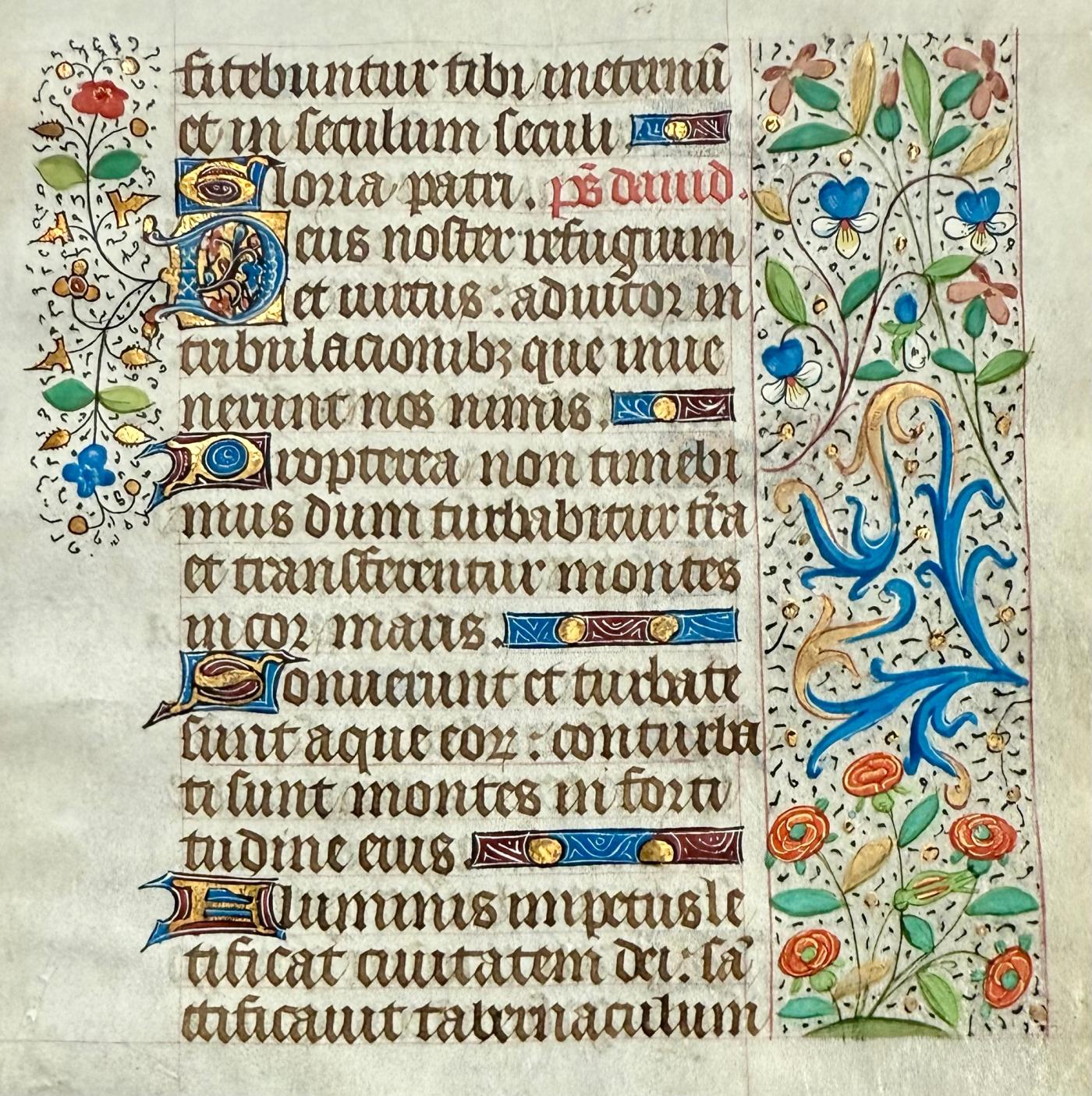
Single leaf from a Book of Hours, of small format, 18 long lines of a rounded gothic textualis in dark brown ink, ruled, the text-block framed by borders to the outer and part of the inner margins. Two-line initial in burnished gold on a parti-coloured blue-and-maroon ground with fine white penwork (the D of Deus noster refugium), with further one-line gold initials on similar grounds, blue-and-maroon ribbon line-fillers with white tracery and burnished-gold bosses, and a one-line rubric in rose-pink (psalmus David). The outer margins carry full borders of naturalistic flowers — blue-and-white pansies, a columbine, red roses, and a blue-and-gold acanthus spray — on a cream ground sprinkled with liquid-gold dots and fine black penwork sprigs; the recto’s inner margin an ivy-spray with burnished-gold trefoil bezants and scattered blooms. Modern collection or stock number in pencil on the verso (‘ST20810 B-23’).
TEXT
The leaf opens in the final verse of Psalm 44 (Vulgate) and continues, after the doxology and a rubric, through nearly the whole of Psalm 45 (Vulgate): …confitebuntur tibi in aeternum, et in saeculum saeculi. Gloria Patri… [rubric: Psalmus David.] Deus noster refugium et virtus, adiutor in tribulationibus quae invenerunt nos nimis. Propterea non timebimus dum turbabitur terra, et transferentur montes in cor maris. Sonuerunt et turbatae sunt aquae eorum, conturbati sunt montes in fortitudine eius. Fluminis impetus laetificat civitatem Dei: sanctificavit tabernaculum suum Altissimus. Deus in medio eius, non commovebitur: adiuvabit eam Deus mane diluculo. Conturbatae sunt gentes, et inclinata sunt regna: dedit vocem suam, mota est terra. Dominus virtutum nobiscum: susceptor noster Deus Iacob. Venite et videte opera Domini, quae posuit prodigia super terram: auferens bella usque ad finem terrae. Arcum conteret, et confringet arma: et scuta comburet igni. Vacate et videte quoniam ego sum Deus: exaltabor… The hand uses the standard abbreviations: the z-shaped -bus sign (tribulacionibz = tribulationibus), que for quae, eoz for eorum, the macron for terminal nasals (vocē suā for vocem suam, virtutū for virtutum), usqz for usque, qm for quoniam, and ds for Deus.
Translation — Psalm 45 after the Douay-Rheims (Challoner) version; the leaf opens in the last line of Psalm 44.
…shall people praise thee for ever; yea, for ever and ever. … Our God is our refuge and strength: a helper in troubles, which have found us exceedingly. Therefore we will not fear, when the earth shall be troubled; and the mountains shall be removed into the heart of the sea. Their waters roared and were troubled: the mountains were troubled with his strength. The stream of the river maketh the city of God joyful: the most High hath sanctified his own tabernacle. God is in the midst thereof, it shall not be moved: God will help it in the morning early. Nations were troubled, and kingdoms were bowed down: he uttered his voice, the earth trembled. The Lord of armies is with us: the God of Jacob is our protector. Come and behold ye the works of the Lord: what wonders he hath done upon earth, making wars to cease even to the end of the earth. He shall destroy the bow, and break the weapons: and the shield he shall burn in the fire. Be still and see that I am God; I will be exalted among the nations…
COMMENTARY
Psalms 44, 45, and 86 form the psalms of Matins for Tuesday and Friday in the Hours of the Virgin, so the leaf belongs to Matins of the Little Office, with the doxology and the rose-pink psalmus David rubric marking the join between the two psalms. (In the Hebrew and modern numbering the second is Psalm 46, “God is our refuge and strength” — the text behind Luther’s Ein feste Burg.) The script, the gold initials on blue-and-maroon grounds, the white-traced line-fillers, and the gold-bezant ivy belong to the accomplished commercial idiom of French or Franco-Flemish illumination of the later fifteenth century; the fuller naturalistic flower borders of the outer margins — pansies, columbine, roses, and acanthus on a gold-sprinkled ground — place it at the richer end of that production. The leaf shares this decorative vocabulary with other Hours of the period and region, but is a distinct manuscript and of notably small leaf-size. A fresh and attractive example, the gold scarcely rubbed.
Enquiries
This piece has been sold. To enquire about a commission or a similar work, please get in touch.