1 / 12
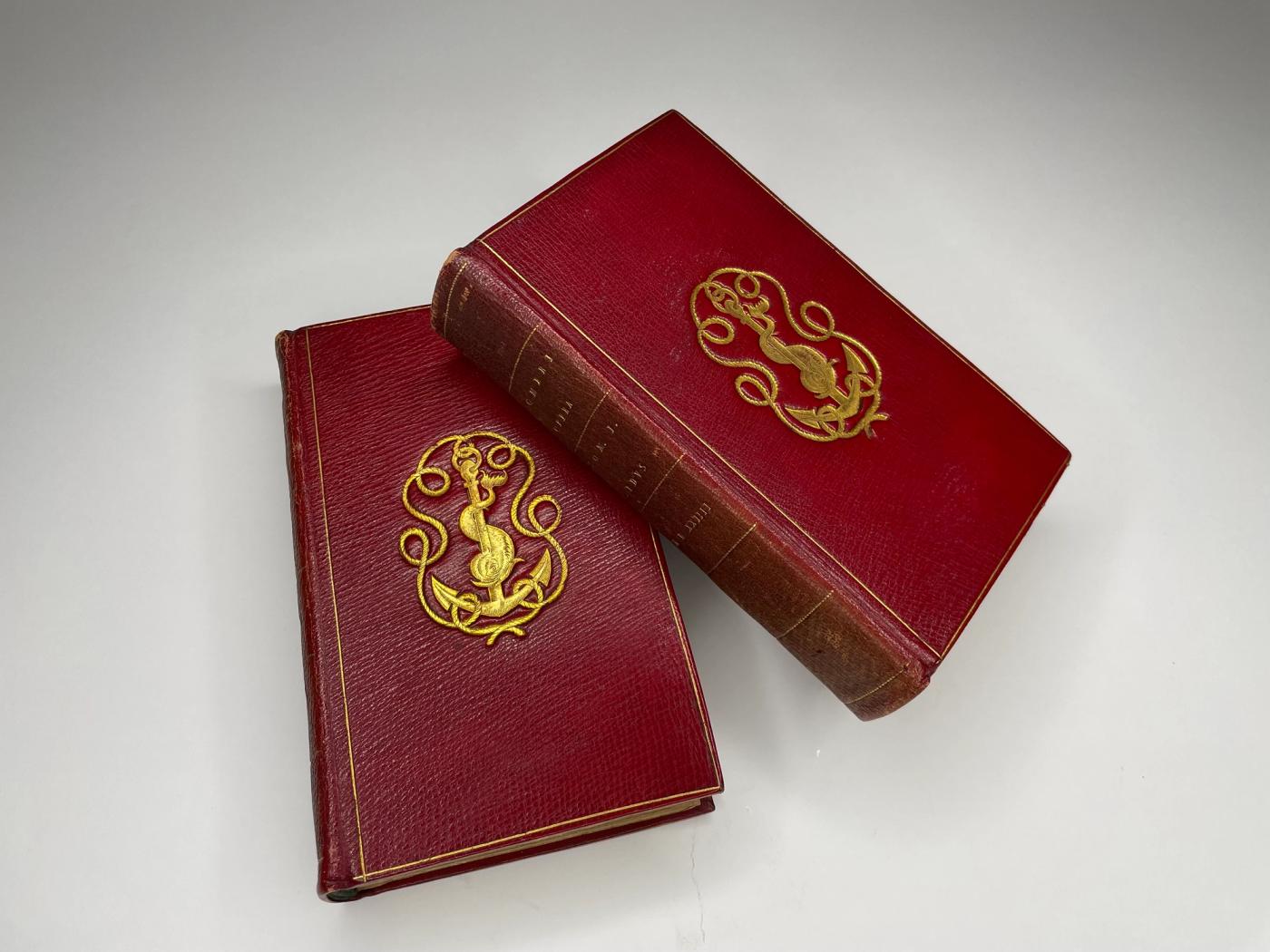
Ilias. Ulyssea. Batrachomyomachia. Hymni XXII. (Venice: in the house of Aldus and Andrea Torresani, [1517?]–1524). 8vo (170 × 105 mm), 277 and 251 unnumbered leaves, text in Greek, woodcut Aldine device on title pages and final versos (final leaf to Ilias supplied from another copy). Title page of Ilias, with Aldus’ address to Girolamo Aleandro, bound after the lives (as often). Full late-18th century straight-grained crimson morocco by Roger Payne for the Thorolds of Syston Park, gilt-ruled spine in six compartments, lettered direct in gilt, boards ruled in gilt with stylised Aldine device gilt-stamped on front and rear boards, all edges gilt and gauffred, marbled endpapers. Slight and uniform fading to spines; top edges slightly soiled. A large, wide-margined copy in a superb regency binding with an illustrious provenance.
The Odyssey volume is unquestionably the third edition, published in 1524. The Iliad is either the first (1504) or second (1517) edition, with the older form of the Aldine device (without open jaws) on the title page. A previous owner, either wilfully or in ignorance, has inserted the register (with later Aldine device on verso) for the Iliad from a copy of the third edition.
Through the course of the late 18th and early 19th centuries, the Thorolds (in particular the 9th and 10th baronets) of Syston Park, Lincolnshire, amassed one of the finest private libraries in Britain, rivalled only by the collections of the Duke of Roxburghe and the Earl Spencer. Many of the finest books from the collection were auctioned over a period of eight days in December 1884 by Sotheby’s. The current set was no. 949 in the 1884 auction catalogue. After a century in the Syston Park library, the volumes passed on to Maurice Baring (1874–1945), the bibliographer and bibliophile A. N. L. Munby (1913–1974), and E. J. Kenney (1924–2019), Kennedy Professor of Latin at Cambridge and author of The Classical Text (1974), a foundational study of the role of early printing in establishing and preserving the texts of Greek and Latin Classics.
The importance of the three Aldine editions of Homer cannot be overstated. The editio princeps, edited by Demetrius Chalcocondyles and printed in Florence in 1488, first brought Homer’s Greek to print in Western Europe. While primarily based on Chalcocondyles’ text, Marcus Musurus (generally thought responsible for preparing Aldus’ edition) improved many of the errors of the princeps, though there is no evidence that he consulted the superior manuscripts bequeathed by Cardinal Bessarion to Venice, which at the time of Aldus’ activity languished as they awaited the construction of what would become the Marcian Library. Furthermore, Aldus’ editions, in convenient octavo format and with significantly larger print runs than the 1488 edition, soon propagated the Homeric text across the continent and beyond: a character in More’s Utopia possesses a copy, while Columbia University Library owns a copy of the second edition inscribed by Philip Melanchthon to Martin Luther.
References: Renouard 98, Adams H745.
Enquiries
This piece has been sold. To enquire about a commission or a similar work, please get in touch.