1 / 8
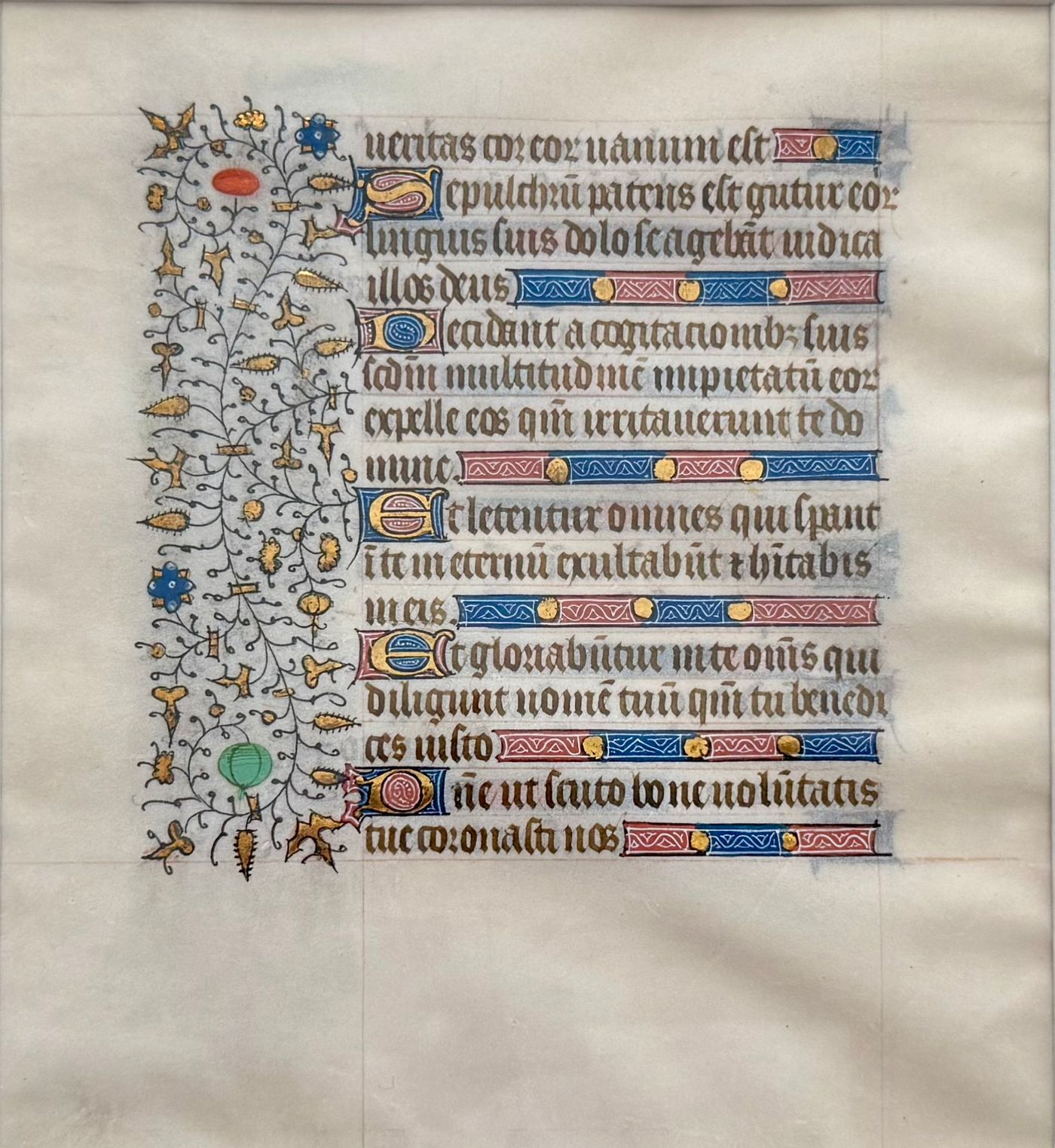
Single leaf, 16 lines of a rounded gothic textualis with cursive (bâtarde) leanings, written in dark brown ink, ruled, with full-height vine border to one margin. Five two-line initials in burnished gold on parti-coloured grounds of blue and maroon heightened with fine white penwork; ribbon line-fillers in the same palette, punctuated with burnished-gold bosses. The outer margin carries a slender ivy-spray border of hairline tendrils strung with burnished-gold trefoil bezants and black penwork sprays, relieved by naturalistic blooms — an orange-red roundel-flower, blue cornflowers, and a green fruit. Reverse not examined; condition apparently fresh, the gold bright.
TEXT: The leaf preserves the close of Psalm 5 (Vulgate; vv. 10–13), the opening psalm of Matins in the Office of the Dead: …veritas; cor eorum vanum est. Sepulcrum patens est, guttur eorum; linguis suis dolose agebant. Iudica illos, Deus. Decidant a cogitationibus suis; secundum multitudinem impietatum eorum expelle eos, quoniam irritaverunt te, Domine. Et laetentur omnes qui sperant in te; in aeternum exsultabunt, et habitabis in eis. Et gloriabuntur in te omnes qui diligunt nomen tuum, quoniam tu benedices iusto. Domine, ut scuto bonae voluntatis tuae coronasti nos.
Translation — after the Douay-Rheims (Challoner) version.
…there is no truth in their mouth: their heart is vain. Their throat is an open sepulchre: they dealt deceitfully with their tongues: judge them, O God. Let them fall from their devices: according to the multitude of their wickednesses cast them out: for they have provoked thee, O Lord. But let all them be glad that hope in thee: they shall rejoice for ever, and thou shalt dwell in them. And all they that love thy name shall glory in thee. For thou wilt bless the just. O Lord, thou hast crowned us, as with a shield of thy good will.
The hand is fluent in the standard liturgical abbreviations: the looped -rum sign for eorum (three times), the suspension scdm for secundum, the -bus sign in cogitationib; (cogitationibus), q̃ for quoniam (twice), the Tironian et, and the macron for terminal nasals throughout (nomē tuū for nomen tuum). The orthography is of its period — letentur, bone, tue for laetentur, bonae, tuae, and the single-t gutur for guttur.
COMMENTARY
Psalm 5 stands first among the three psalms of the opening nocturn at Matins of the Office of the Dead (the Dirige), so the present leaf falls at the very head of that office — one of the standard and most substantial components of a Book of Hours. The rounded liturgical script, the gold initials on blue-and-maroon grounds with white tracery, the bossed ribbon line-fillers, and above all the fine ivy-rinceaux border sown with gold bezants and a sparing scatter of coloured flowers belong to the common idiom of accomplished commercial illumination of the third quarter of the fifteenth century — at home in Paris, Rouen, or the workshops of the Southern Netherlands alike. On the evidence of a single leaf a tighter localisation is best left open. A fresh and charming example, the burnished gold scarcely rubbed.
A further leaf from the same dismembered Book of Hours is recorded — identical in script, palette, and border vocabulary — preserving the close of Psalm 147 and the opening of the hymn Ave maris stella at Vespers of the Hours of the Virgin. The two are offered separately; the present leaf is complete in itself.
Purchase & Shipping
To purchase this piece or enquire about shipping, please use the Purchase or Enquire button above.