1 / 18
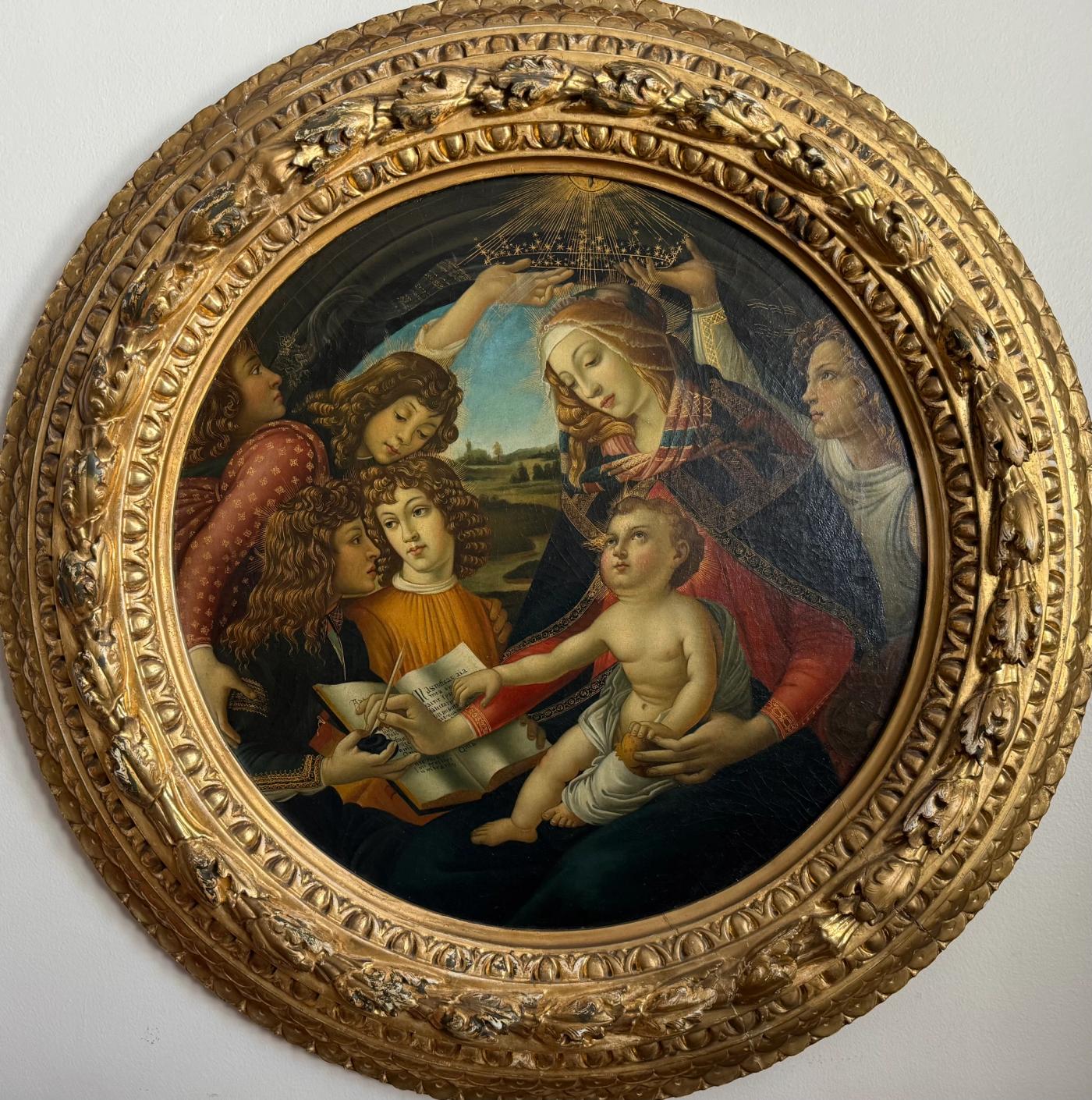
The composition is among the most celebrated of the Florentine Renaissance: Sandro Botticelli’s Madonna of the Magnificat, painted about 1483 and acquired for the Uffizi in 1784, where it remains one of the gallery’s treasures. A tondo — the circular format that Florence favoured for the private devotional pictures of its great households, frequently commissioned to mark a marriage or a birth — it shows the Virgin with the Christ Child on her lap, attended by five youthful, wingless angels in the fashionable guise of Florentine pages. Two raise above her head a crown of stars amid a burst of golden rays, marking her Queen of Heaven; the others steady the open book in which, her hand guided by the Child, she writes the opening of her own canticle of praise. That text gives the picture its name: on the right-hand page she has begun the Magnificat — Magnificat anima mea Dominum, ‘My soul doth magnify the Lord’ (Luke 1:46) — while the facing page carries part of the Benedictus, the song of Zechariah. In the Child’s hand is a pomegranate, its crowded red seeds a long-established emblem of the Passion to come.
Like many of Botticelli’s greatest works, the painting exists at the intersection of sacred devotion and contemporary Florentine society. Since Vasari, it has been suggested that several of the figures were modelled after members of the Medici circle, and tradition has associated the youthful angels with Lorenzo de’ Medici and his brother Giuliano, while the refined, idealised beauty of the Virgin is thought to have been inspired by Lucrezia Tornabuoni—poet, patron, wife of Piero and mother of Lorenzo. Whether intended as literal portraits or as elevated allusions to Botticelli’s patrons, such associations remind us that the great devotional images of fifteenth-century Florence were deeply embedded in the political, intellectual, and social world that produced them.
The picture belongs to the maturity of Botticelli’s art, the years around his work on the walls of the Sistine Chapel, when his line had attained its full lyric refinement and gold was lavished on hair and hems. Its conception is at once devotional and humanist. Convention showed the Virgin as a reader; Botticelli shows her as a writer — an author of sacred scripture, under the Child’s direction — and sets the heavenly coronation above against an earthly Tuscan landscape glimpsed through a window framed in pietra serena, so that the circle holds Paradise and the world together in a single harmonious whole. The pale, porcelain faces, the rhythmic fall of the draperies, and the grave, downcast beauty of the Virgin made the image one of the most beloved of all Botticelli’s Madonnas — admired and imitated already in his own century, and copied without interruption since.
By the second half of the nineteenth century that fame had become an industry. The rediscovery of Botticelli by the Pre-Raphaelites and by the critics of the Aesthetic movement — Ruskin, and above all Walter Pater, whose essay of 1870 fixed the cult — made his Madonnas objects of near-devotion across England and America, and the copyists of Florence, many of them trained restorers and decorators working within sight of the Uffizi, supplied the demand with painted replicas of his most admired tondi. The Madonna of the Magnificat and the Madonna of the Pomegranate were the two most frequently reproduced. The better Florentine hands signed their copies openly — the gouache-and-gold Magnificat tondi of Giovanni Battista Nardelli are a documented instance — while many fine examples, like the present one, went out unsigned. The general run of this production was competent but mechanical. The present picture is emphatically not of that run.
It is a copy of exceptional accomplishment, among the finest of its kind to be encountered. The pair of angels’ heads at the left — one in near-profile, one turned out toward the viewer — are modelled with a sureness of drawing and a porcelain delicacy that genuinely answer to Botticelli’s own, and the Virgin’s downcast face keeps its grave sweetness intact. Throughout the hair the copyist has reproduced the master’s gold itself, laying fine hatched strokes of shell-gold over the curls exactly as a quattrocento panel would carry them — slow, skilled, deliberately archaising labour far beyond the reach of the ordinary commercial copy. Our version follows the Uffizi picture with incredible fidelity, retaining the delicacy, proportionality, and colour palette of the original. Particular attention has been paid to the fine rendering of the faces and hands, areas that often betray a copyist’s limitations, but which here are handled with unusual confidence and sensitivity. The inscription is transcribed with the same fidelity, the Magnificat and the Benedictus both legible on their facing pages down to the Quia catchword. The surface has taken a fine, even craquelure consonant with its age. The grand carved and giltwood tondo frame completes a copy conceived, and executed, well above the level of its kind.
Purchase & Shipping
To purchase this piece or enquire about shipping, please use the Purchase or Enquire button above.