1 / 16
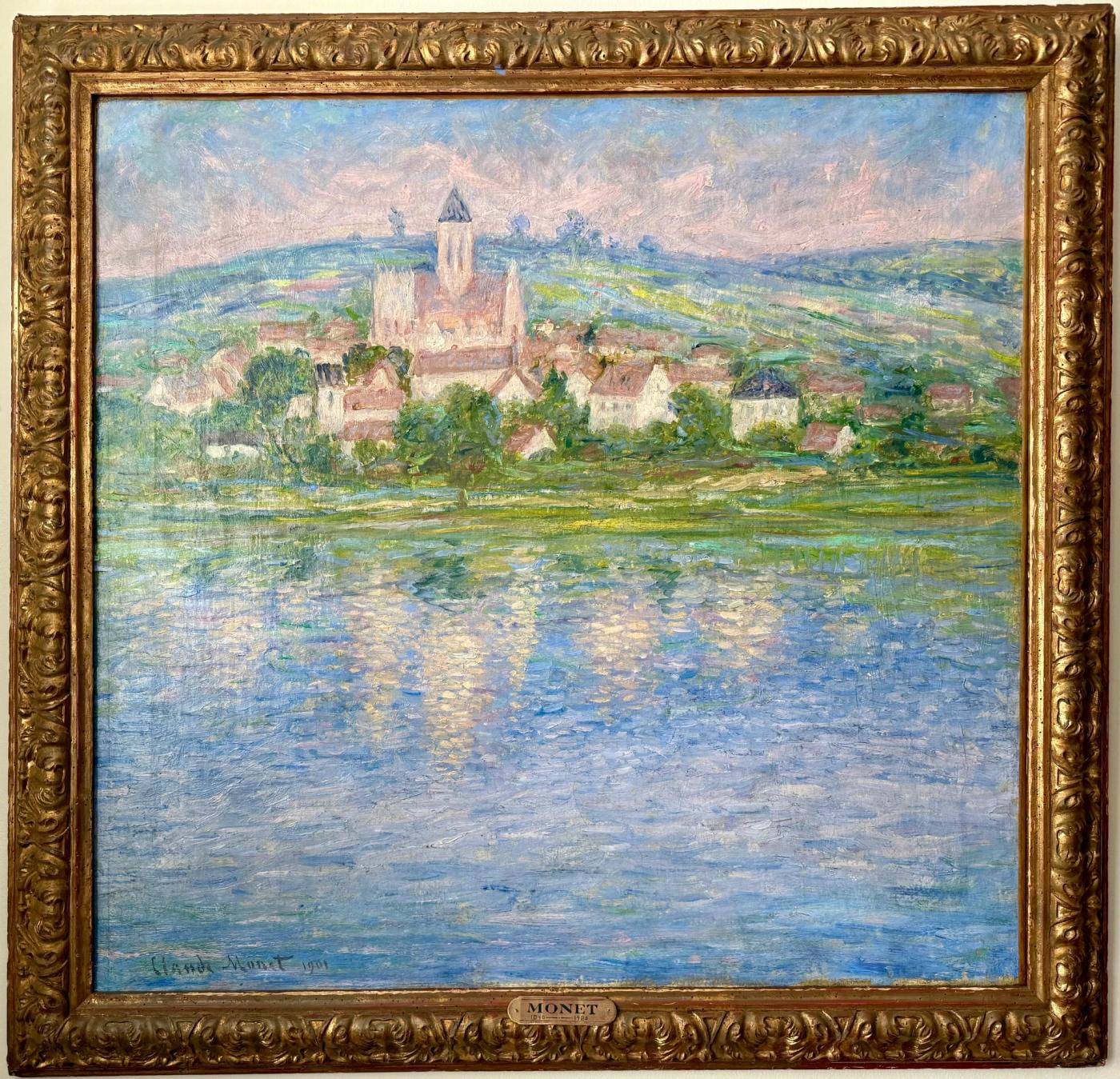
In the summer of 1901 Claude Monet returned to a motif that had occupied him two decades earlier. He had lived at Vétheuil, the small town set on a bend of the Seine north-west of Paris, from 1878 to 1881, through some of the hardest years of his life; now, established and prosperous and master of the garden he was enlarging at nearby Giverny, he came back to look at it again — not from the town but from across the water. Renting a house at Lavacourt on the opposite bank, he set up on a balcony above the river and painted the same fixed prospect over and over: the village strung along the far shore, the tower of the church of Notre-Dame de Vétheuil rising at its centre, and the broad Seine carrying the whole scene a second time in reflection. Some fifteen canvases resulted, recording the motif under the changing light of the day, from clear midday to the flush of sunset; they are today dispersed among major public and private collections, two of them in the Art Institute of Chicago.
The 1901 Vétheuils are among the most purely pictorial of Monet’s serial campaigns. He worked them on nearly square canvases and divided each almost evenly between the town above and its reflection below, so that the real and the mirrored hold the surface in near-equilibrium. Topography is secondary; what he pursued was the dissolution of one thing into another — water into land, land into sky, substance into its own shimmering double — until the village reads less as a place than as an occasion for light and colour. Forms surface and recede through shifts of hue and the changing direction of the touch rather than through drawing, and the decorative instinct that would carry him on to the water-lilies is already fully in play.
The present canvas reprises this composition, following most closely the midday version in the Art Institute of Chicago (Mr. and Mrs. Lewis Larned Coburn Memorial Collection, 1933.447; 90.2 × 93.4 cm), itself inscribed Claude Monet 1901 at the lower left. It is, however, an interpretation rather than an exact copy, freely reordering the handling and the play of the reflections to its own ends — and it is an accomplished thing in its own right. The lilac and rose of the sky are scumbled wet-into-wet; the hillside is built up in short, laden strokes of green and ochre; and the broad foreground of water — the passage on which any version of this motif stands or falls, and here the most assured — is carried in a mosaic of golden, blue, and violet touches that holds its structure across the entire lower half of the canvas. The surface bears a fine, even craquelure and a mellowed tonality. Throughout, this is the work of a painter thoroughly schooled in the Impressionist touch, far removed from the routine decorative copy. (Cf. D. Wildenstein, Claude Monet: Biographie et catalogue raisonné, Lausanne and Paris, 1974–91, vol. IV, the Vétheuil series of 1901.)
The painting is the work of a later hand, executed in the second half of the twentieth century. It is not by Claude Monet; it does not appear in the catalogue raisonné, and the signature is not that of the artist. The signature and date Claude Monet 1901, lower left, appear integral to the paint surface and to have been laid in by the painter of the present work rather than added subsequently by another hand; the canvas has not, however, been examined under ultraviolet light. The frame carries a nameplate to the same effect. It is offered for precisely what it is — a free version of exceptional skill after one of the most admired compositions of Monet’s maturity, bearing a spurious signature; a class of object with its own following among collectors of Impressionism and its imitators.
Purchase & Shipping
To purchase this piece or enquire about shipping, please use the Purchase or Enquire button above.