1 / 13
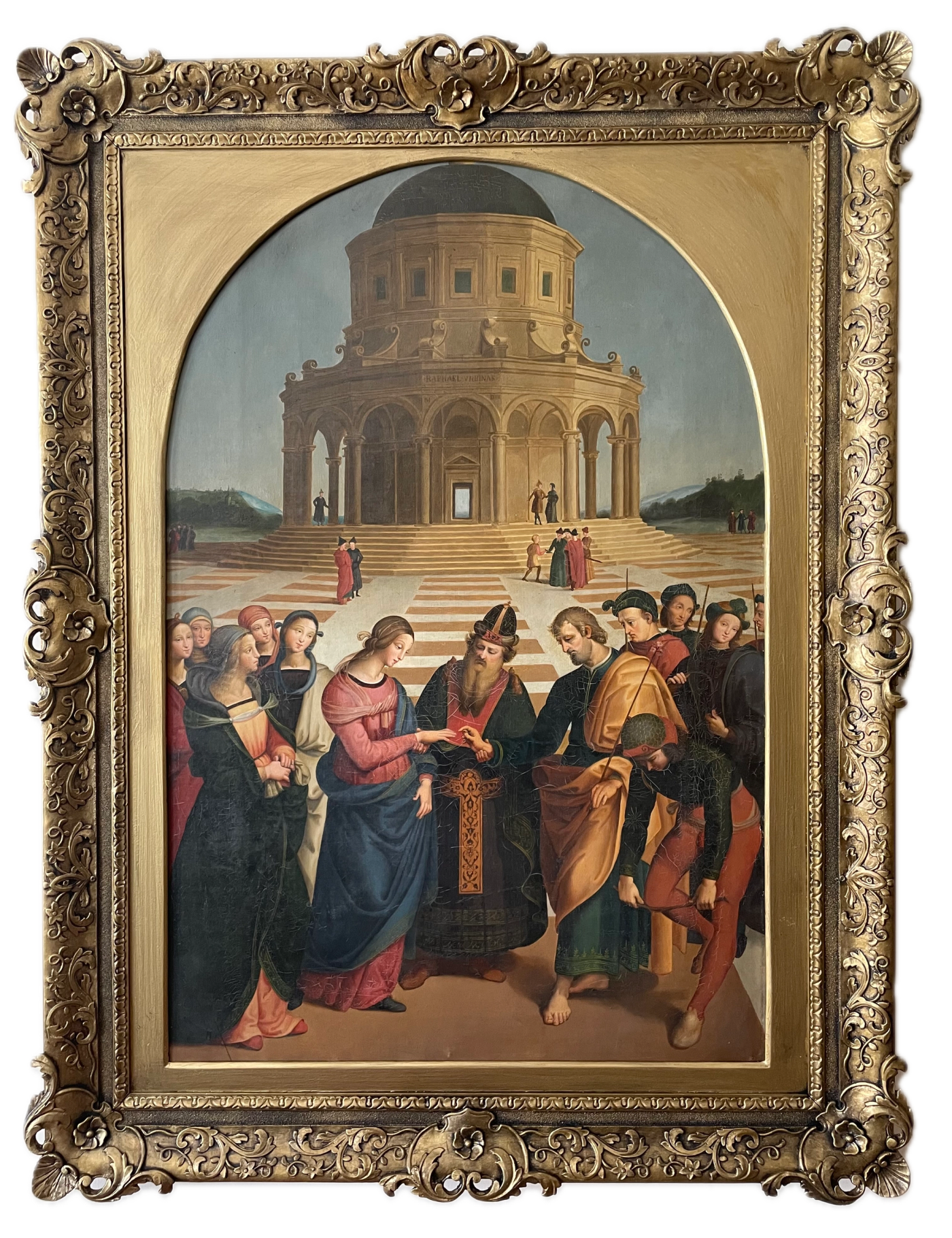
A truly superb and imposing early copy by an unknown Master of Raphael’s Marriage of the Virgin, now in the Pinacoteca di Brera in Milan. Raphael’s original (some 30% larger than the present copy) was completed in 1504, for the Albezzini family chapel in the church of San Francesco in Città di Castello in Perugia, where it remained until the Napoleonic Wars.
Not mentioned in the canonical Gospels, the marriage of Mary and Joseph became a popular theme in late medieval and Renaissance art due to the popularity of the Legenda Aurea — Golden Legends — of Jacobus de Voragine, a mid-13th century collection of hagiographies. Giotto famously painted a Marriage of the Virgin as part of his monumental fresco cycle in the Scrovegni chapel in Padua. Of more immediate note, Pietro Perugino, Raphael’s mentor, completed a Marriage of the Virgin for Perugia’s cathedral in 1503 (now in the Musée des Beaux-Arts in Caen), and since Vasari it has been acknowledged that Raphael’s painting is heavily indebted to that of his master.
In Raphael’s composition, the lower half of the scene is dominated by the human figures, Mary and her retinue on the viewer’s left, Joseph and competing suitors on the right, and the high priest in the centre, bridging the two groups. The precise moment of union is depicted, with the priest guiding the couple’s hands together, Joseph holding out a ring and Mary stretching forth her finger. In the Legend, suitors would arrive at the Temple in Jerusalem seeking Mary’s hand carrying branches — Joseph’s miraculously blossomed, a sign of divine favour (the blossoms at the tip of Joseph’s branch, somewhat faded, are visible in our painting). A frustrated suitor in the foreground breaks his barren branch against his knee.
The upper half of the scene is dominated by an idealised and Classically inspired hexadecagonal structure with a peristyle porch representing the Great Temple in Jerusalem. Here Renaissance fascination with perspective dominates. A paved piazza retreats towards the steps of the temple, while an open set of doors on either side — perfectly aligned with the viewer’s perspective — allows the vanishing point on the horizon — just visible at the bottom of the open doorway — to be seen unobstructed. Raphael’s Latin ‘signature’ and the date adorn the otherwise unadorned façade of the building, in both the original and our copy.
Raphael’s original is one of the true masterpieces of Italian Renaissance art, while the copy offered here, resplendent in its accompanying frame, is about as perfect and flawless a copy as can be found anywhere.
Purchase & Shipping
To purchase this piece or enquire about shipping, please use the Purchase or Enquire button above.