1 / 6
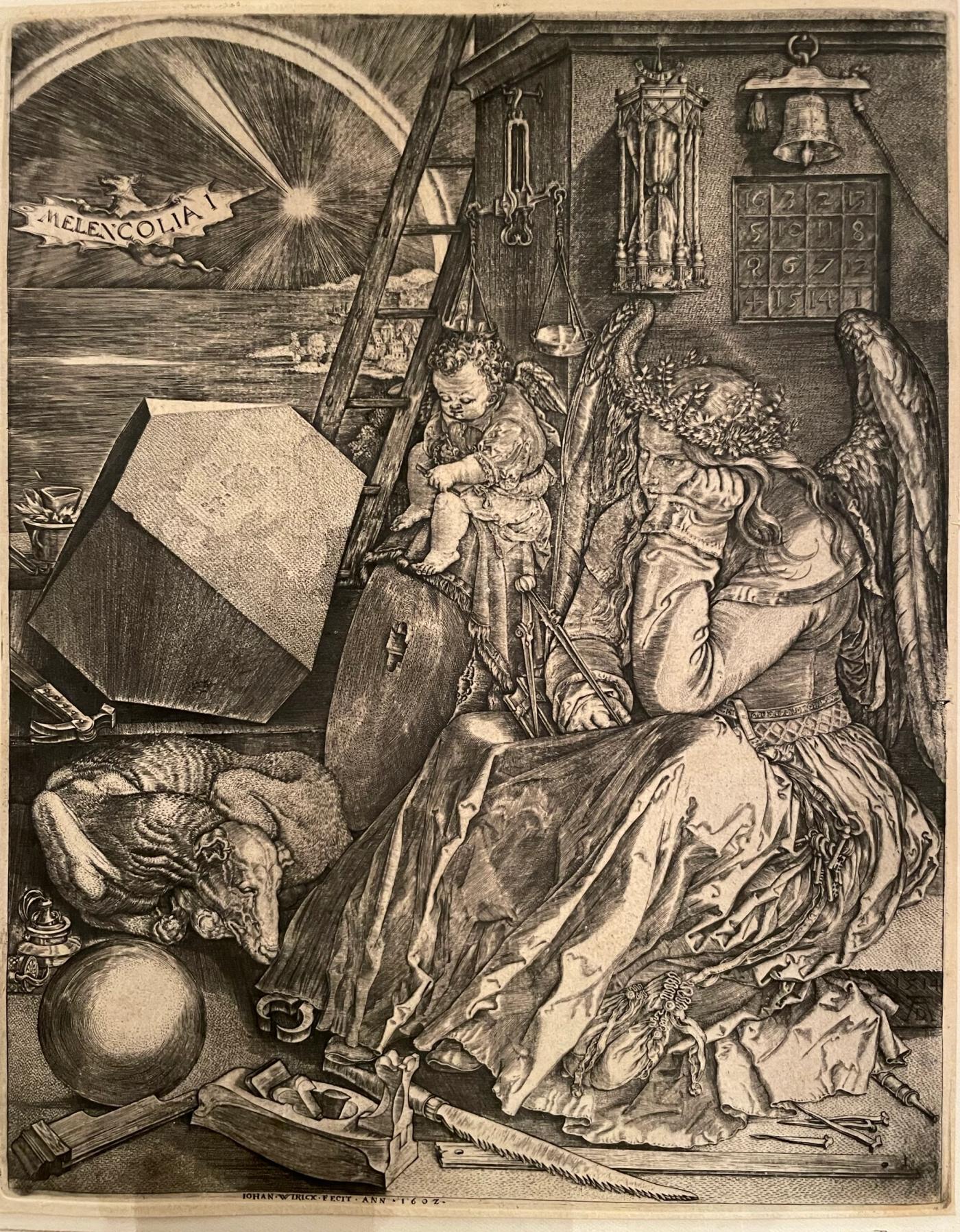
Signed and dated in the matrix Iohan Wiricx fecit ann. 1602.
A fine example of Wierix’ famous, ‘exact’ copy of Dürer’s Melencolia (Melancholia), arguably the greatest engraving of the Renaissance, and one of the most sought-after of all Old Master prints. In Dürer’s composition, an angelic, winged female figure — presumably the personification of Melancholia — sits, head in hand, broodingly staring off into the distance, surrounded by a bizarre array of items. A putto sits atop a millstone, pen and book (or tablet) in hand, as a hound sleeps at the winged figure’s feet. A shooting star illuminates the sky, while a bat flies towards the viewer, bearing the title-card for the engraving. Objects connected with carpentry, alchemy, and numerology litter the scene. A magic square gives the date in the bottom two centre cells.
Johannes Wierix was one of the greatest Flemish engravers of the northern Renaissance. While he had copied a number of Dürer’s engravings in his youth, the Melencolia is a work of his mature years, and a tour de force of exceptional skill, with practically every single line and detail of Dürer’s original copied exactly. It is thus a masterwork in its own right, as well as being a near-perfect early after Dürer.
Most copies of Wierix’ Melencolia are trimmed to the plate. The present example, with comparatively wide margins, Wierix’ signature clearly visible, and the impression of the copper plate visible on all sides, is thus particularly fine and rare. The Metropolitan Museum of Art holds an impression in their collection — view at the Met.
Enquiries
This piece has been sold. To enquire about a commission or a similar work, please get in touch.