1 / 14
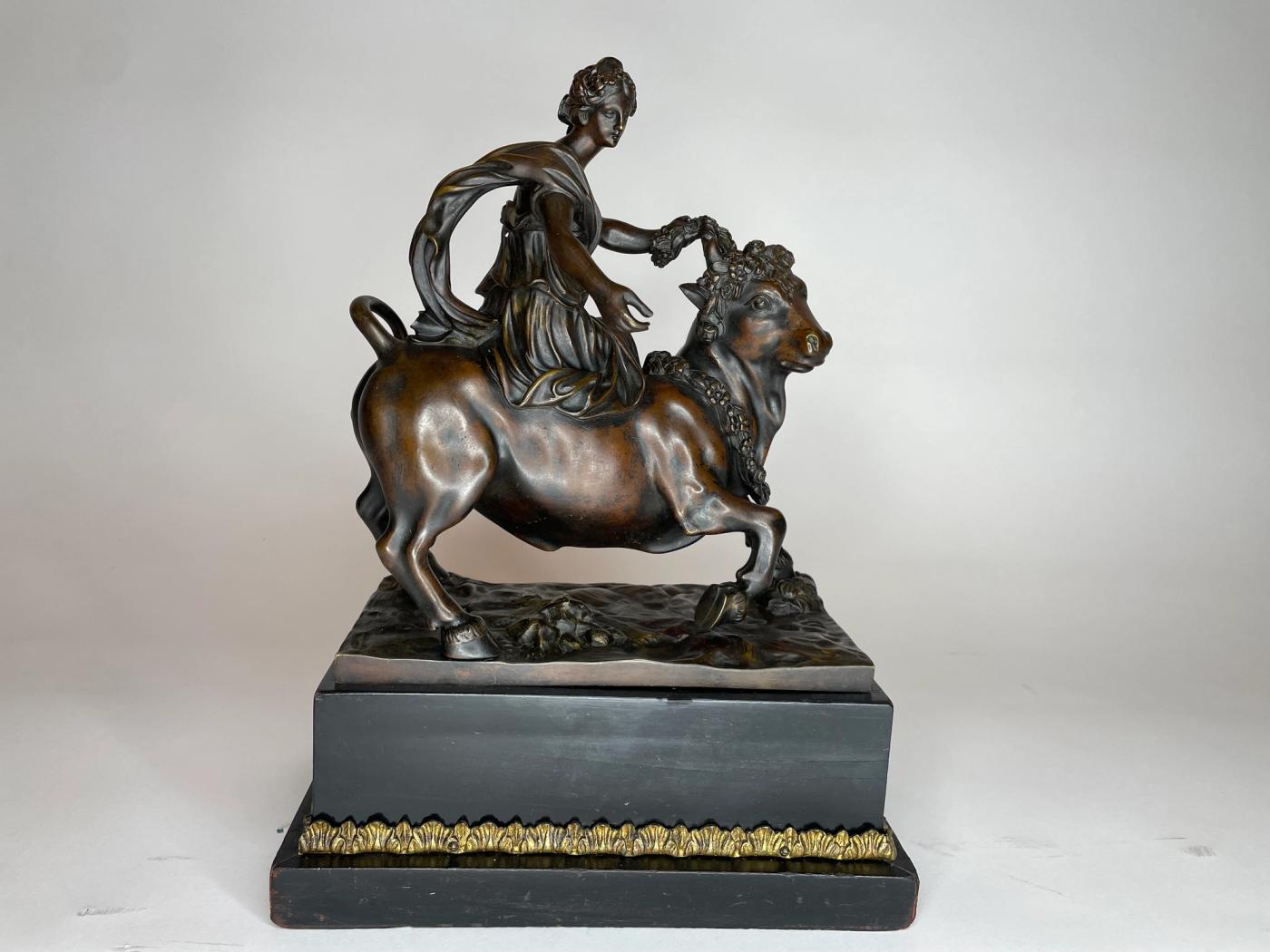
This sculpture can be associated with several similar to identical castings attributed to a Parisian workshop at the turn of the 18th century. The only notable variation between the two models produced by the workshop is the presence or absence of a garland of flowers around the bull's neck. An example in the Dresden Museum was purchased in 1699 for Augustus the Strong, Elector of Saxony. Another example is in the royal collection of Sweden at Drottningholm Castle, purchased in Paris prior to 1740.
A unique example was sold at Sotheby's New York in July 2023, in which the Europa and the Bull group is set upon a larger base with the addition of two nymphs. According to the Sotheby's catalogue, the larger sculptural group is secondary to the original model. However, the physiognomy of the larger group — with Europa's outstretched arm and open hand ready to receive flowers being offered up by the nymphs — rather suggests that the larger group was the original conception, from which the more commonly found group offered here was abstracted. Thus, contrary to the catalogue notes for an earlier Sotheby's sale (January 2008), there is likely nothing missing from the figure's right hand.
The myth of the rape of Europa (from Latin raptus, 'snatched away, abducted', translating Greek harpagē) is an aetiological myth explaining the naming of the European continent. Europa was a Phoenician princess. Zeus, filled with desire upon seeing her, transformed himself into a beautiful bull and manifested himself before her. Europa climbed upon his back, and the bull flew — or swam, in some versions — away to Crete. Reverting to his anthropomorphic form, Zeus lay with Europa, producing Minos and Rhadamanthus (and, according to later sources, Sarpedon).
A magnificent example with fine brown/black patina of this rare and sought-after sculpture.
Enquiries
This piece has been sold. To enquire about a commission or a similar work, please get in touch.