1 / 9
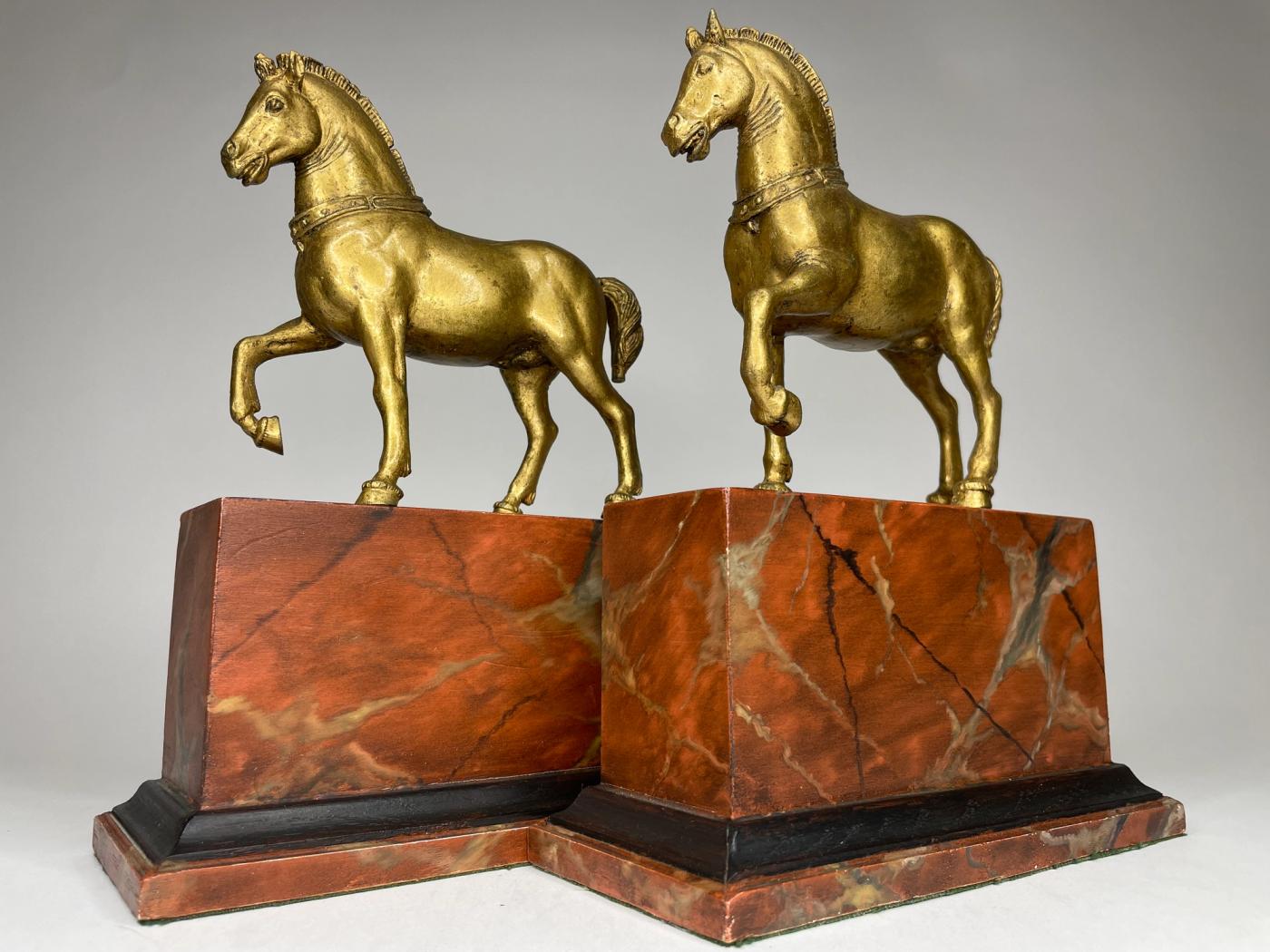
A spectacular pair of gilt bronzes from the quadriga of Saint Mark, the Romano-Byzantine horses that long adorned the balcony of Saint Mark’s basilica in Venice (now in a museum within the basilica, with replicas on the balcony), atop a pair of imposing and expertly rendered hand-painted faux-marble wooden pedestals.
The Horses of Saint Mark are among the most storied physical objects in the western world. The originals were likely cast in the early Imperial period, 1st–3rd centuries AD, though some have argued they might even be classical in date (they are stylistically Greek). Wherever they originally stood, they were transported to Constantinople in the early Byzantine period (by or before the reign of Justinian), and are possibly to be identified with the horses of the quadriga opposite the starting-post of the hippodrome recorded in Byzantine sources. They remained in Constantinople for the better part of a millennium, until the Fourth Crusade in 1204 AD, when they were looted by the conquering Venetian and Frankish forces and taken to Venice, where they ended up on the balcony of Saint Mark’s basilica for centuries. They were looted again by Napoleon’s forces in 1797 and taken to Paris, where they were placed atop the Arc de Triomphe du Carrousel (in the Tuileries gardens). They were returned to Venice after the Battle of Waterloo in 1815, to their former place on the loggia of San Marco, where they remained until being replaced with replicas in the 1980s.
The horses of Saint Mark hold a central place in equestrian iconography from the Renaissance onwards. The distinctive knotted forelock and cropped, ‘Greek’ mane are already noticeable in Donatello’s equestrian sculpture of Gattamelata (c. 1453), as opposed to the Roman style flowing mane of the equestrian statue of Marcus Aurelius, which in turn is seen in Verrocchio’s group of Bartolomeo Colleoni (c. 1488). In the same manner, while Giambologna’s equestrian sculpture of Cosimo I de’ Medici in Florence has a traditional flowing mane, some small castings from Giambologna’s workshop (e.g. Met Museum 24.212.23), and that of his successor Susini, again show the knotted forelock and Greek mane, derived ultimately from the Horses of Saint Mark.
An exquisite and unique sculptural group that presents well in any setting.
Enquiries
This piece has been sold. To enquire about a commission or a similar work, please get in touch.